海报展示
清华大学职业发展中心(华为厅,1层)11:15–12:15 / 13:30–14:30 / 15:00–16:00
Event Venues
清芬园食堂南侧;不同环节请按楼层和区域前往。
11:15–12:15 / 13:30–14:30 / 15:00–16:00
参展企业将提供优质伴手礼,欢迎前往交流。
09:00–11:30 / 13:00–18:00
14:00–15:30
Presenter Guide
请在对应 session 开始前 20–30 分钟到华为厅入口处海报签到台签到。
需要代打印的同学领取纸质海报、编号牌和海绵胶;自带海报的同学领取编号牌和海绵胶。
按网页编号找到对应展位完成张贴,等待工作人员确认。
在对应 session 时间段内留在海报旁讲解,与企业嘉宾和现场同学交流互动。
session 结束后到签到台签退,工作人员确认完成展示后记录参与资格。
完成签到、张贴、展示、签退的同学可参与抽奖;评奖和领奖安排后续在海报群公布。
Exhibitor Guide
供企业嘉宾入校、停车、抵达活动区域使用。
建议从清华大学东北门入校。
建议停在北体育馆和综合体育馆附近。
职业发展中心与祖龙广场,均在清芬园食堂南侧。
Forum Topics
主论坛与分论坛位于职业发展中心浪潮厅(B2层),产品教学展示位于天一厅(B2层)。
09:00–11:30 · 浪潮厅(B2层)
13:00–14:30 · 清华大学职业发展中心 浪潮厅 B2层
14:45–16:15 · 清华大学职业发展中心 浪潮厅 B2层
16:30–18:00 · 清华大学职业发展中心 浪潮厅 B2层
14:00–15:30 · 天一厅(B2层)
Timeline
Poster Index
按文章为单位展示;同一文章多位同学共享一个编号。
S1 · 11:15–12:15 · 华为厅(1层)
AI for Science、AI for Medicine、AI+社科、能源、网络、形式化验证与跨学科应用。
Cities account for the majority of global energy consumption and carbon emissions, making urban energy transition the cornerstone of achieving carbon neutrality. However, existing policies and research often fail to adequately integrate diverse stakeholder needs when developing future carbon neutrality scenarios, leading to insufficient feasibility assessments of low-carbon technologies and policies, and increasing uncertainty in urban energy transition. This study addresses this gap by proposing a hybrid methodological framework that combines traditional energy system analysis tools, Energy Allocation Analysis (EAA), Logarithmic Mean Divisia Index (LMDI) and System Dynamics (SD), with advanced AI techniques including Multi-Agent Reinforcement Learning (MARL), Generative AI (GenAI) and Large Language Model (LLM). Using Beijing as a case study with 2000-2020 historical data, we characterize driving factors across energy, population, economic and policy dimensions, then generate and compare five 2060 carbon neutrality scenarios that coordinate multi-stakeholder interests. Our results demonstrate that AI methods do not provide a single correct future but significantly expand the boundaries of plausible scenarios. Non-AI approaches complement AI by offering domain-specific expertise and technical validation. We conclude that urban carbon neutrality planning should abandon the pursuit of a single optimal path. Instead, AI-generated scenario sets should be used for stress testing and resilience planning, supported by modular, switchable policy toolboxes that can adapt to evolving stakeholder demands and system conditions.
NeurIPS 2026 Submission
Accurately identifying alternative protein conformations remains a fundamental challenge, particularly when functionally relevant states are encoded by sparse evolutionary signals within large multiple sequence alignments (MSAs). In this work, protein conformation prediction is formulated as a combinatorial search problem in MSA space, shifting the focus from structure divergence to evolutionary information discovery. We introduce MSA-Evolver, an optimization framework that enables LLM with direct manipulation and iterative exploration of MSAs. With unified action space and feedback-guided multi-step reasoning strategy, our framework efficiently identifies informative sub-MSAs under limited folding budgets and substantially improves the prediction accuracy of alternative conformations, including open-closed, inward-outward, apo-holo, fold-switching, and intrinsically disordered proteins.
ACSM 2025
Purpose: Recovery status plays a critical role in optimizing training loads and preventing overtraining in athletes. While previous studies have investigated recovery in various athletic populations, there remains a gap in the literature regarding the application of ensemble machine learning models to predict recovery status in professional male basketball players. Methods: A total of 72 variables were monitored, including daily nutrition intake, PlayerLoad, sleep quality and patterns, heart rate variability (HRV), and subjective well-being and recovery status, over a 36-week period from 53 professional male basketball players. 23 predictors were finally selected based on the random-forest-based Boruta algorithm. Four ensemble machine learning models — Random Forest, Extreme Gradient Boosting (XGBoost), Adaptive Boosting (AdaBoost), and Light Gradient Boosting Machine (LightGBM) — were employed to predict recovery status. SHAP (Shapley Additive Explanations) and LIME (Local Interpretable Model-agnostic Explanations) were utilized to interpret the models and identify the most influential predictors of recovery status. Results: Among the ensemble methods, XGBoost demonstrated the best performance (root mean square error [RMSE]: 7.2 points; R²: 0.79). SHAP and LIME analyses revealed that sleep quality, HRV, and muscle soreness were the most significant predictors of recovery status. Prediction error varied significantly across individuals, with RMSE ranging from 5.6 to 14.3 points, highlighting the importance of personalized factors in recovery prediction. Conclusion: XGBoost proves to be an effective tool for predicting recovery status in athletes. SHAP and LIME provide valuable insights into the decision-making processes of these models. The individual variability in prediction accuracy underscores the need for further personalization to enhance model performance.
ACL 2026 Oral
大语言模型智能体在多轮交互任务中依赖强化学习进行策略优化,其中GRPO因无需价值网络而被广泛采用。然而,GRPO在多轮场景下存在两个关键缺陷:episode层面,z-score标准化对所有任务施加相同梯度强度,忽视了任务难度差异——简单任务上的失败可能只是随机噪声,而困难任务上的成功则代表真正的能力突破;step层面,硬边界状态分组导致高维空间中大量步骤陷入单例退化,无法获得有效的对比基线。 ProxMO提出两级信用分配机制。Episode层面,极化信号控制器(PSC)根据任务成功率动态调制梯度强度:对低成功率任务中的成功放大奖励信号以巩固突破,对高成功率任务中的失败抑制惩罚以降低噪声干扰。Step层面,近端软聚合(PSA)用TF-IDF语义相似度替代离散分组,通过温度缩放的softmax为每个状态构建连续加权基线,使所有步骤都能按语义远近获得比较信号。两级优势函数最终统一为联合信用分配。 实验表明,ProxMO在ALFWorld和WebShop上均取得显著增益,较GRPO大幅提升,并超越GPT、Gemini。该方法与标准GRPO即插即用,无需修改模型架构,训练开销极低。
Energy; ICAE 2025
ACL 2025
Journal of Advances in Modeling Earth Systems
The South Pacific convergence zone (SPCZ), a band of strong rainfall that stretches diagonally across the South Pacific from northwest to southeast, is difficult for climate models to simulate well. Here, we suggest that much of this difficulty stems from underestimating both how much heavy rainfall is produced in the SPCZ and how high above the surface this rainfall forms. The SPCZ has previously been described as a “graveyard” for weather systems. Our hypothesis casts the SPCZ more as a toll collector and suggests that the vertical location of the collection point is key. Simulated weather systems that produce heavier rainfall as they move through the SPCZ region release energy higher in the atmosphere, providing the SPCZ with the means to maintain itself. A model that releases this energy lower in the atmosphere by producing too much light rain allows many weather systems to bypass the toll, weakening the simulated SPCZ and drawing it equatorward in search of the energy it needs.
Reliability Engineering & System Safety
Light: Science & Applications
Artificial Intelligence Review
The integration of artificial intelligence (AI) is profoundly reshaping psychological research and practice, creating a dynamic and complex landscape. This study systematically maps the field of “AI-empowered psychology” to delineate its thematic structure, developmental trajectory, and publication patterns. We conducted a BERTopic-based bibliometric analysis of 9190 documents (2000–2025) from the Web of Science Core Collection. The analysis identified 24 distinct research topics clustered into eight domains: Human-AI Interaction, Cognitive Modeling, AI-assisted Applied Psychology, Physiological Signal Processing, Computational Personality and Social Psychology, Computational Psychiatry, Digital Mental Health Intervention, and Affective and Creative Computing. These domains exemplify the extensive integration of AI within psychology, showcasing its dual function: as a powerful tool to advance the scientific goals of description, explanation, prediction, and control, and as a novel research object in its own right. Temporal analysis revealed a two-phase evolution, propelled by technological breakthroughs such as deep learning and large language models (LLMs). Publication analysis highlighted key international research hubs and collaboration networks, while also revealing potential geographic diversity challenges. This comprehensive mapping provides a valuable framework for researchers to navigate the evolving field of AI-empowered psychology, illuminating current frontiers, developmental trends, and critical considerations for future research and application.
This study explores advancing NbSi alloy machining using ultrasonic grinding, with a focus on additively manufactured (AM) variants, whose machining behavior remains largely unexplored despite growing interest for high-temperature applications. Ultrasonic grinding significantly reduces grinding temperature by ~40–50% (from ~125 °C to ~70 °C at 10,000 rpm) and lowers hotspot temperatures from ~54 °C to ~49 °C at 6000 rpm, as confirmed through thermal imaging. The process produces smoother surfaces with fewer machining marks and improved grit engagement, enabling more uniform material removal. Additionally, the dominant cutting force component (Fz) is reduced, and tool wear is notably minimized, demonstrating superior performance.
ICML 2026
Program termination is a fundamental liveness property in software verification. Proving termination of a given program is a formidable challenge due to the undecidability of the problem. In this paper, we propose LIFT, a termination verification framework that leverages LLMs to generate loop bounds within a guess-and-check workflow. LIFT couples this generation with a sound formal validation procedure that both guarantees all reported terminations and refutes invalid loop bounds via violation analysis. Experiments on publicly accessible termination benchmarks show that LIFT significantly outperforms existing termination verification tools.
包含两篇工作:一篇发表在Nature Communications,一篇未发表
在基于质谱的蛋白质组学中, 肽段鉴定是核心的计算挑战。 传统的数据库搜索 依赖预设参考序列库,且仅支持有限的翻译后修饰匹配, 因此难以识别由单氨基酸多态性、复杂翻译后修饰和非经典开放阅读框等非经典生物学事件产生的肽段,这导致大量谱图未被注释,形成蛋白质组“暗物质”,针对这部分数据的挖掘对于深入理解蛋白质组的功能复杂性具有重要价值。 本研究从基础表征学习与专用任务建模两个层面开展方法学创新:其一,基于自监督学习范式,开发质谱数据的基础模 型 π-SPECFormer,其在多个下游任务中达到当前最优水平,验证了其作为质谱数 据通用表征基础设施的有效性;其二, 基于从头训练范式, 设计基于非自回归架构 的专用模型 π-PrimeNovo, 将肽段准确率从现有的 30%–50%大幅提升至 60%–70%, 同时推理速度较现有最优模型提升 80 倍以上,实现了精度与效率的双重突破。 应用层面,本研究依托上述模型,在多个生物学场景中实现了蛋白质组“暗物质” 的深度挖掘、功能分析及验证。 基于 π-SPECFormer,本研究构建了一条涵盖 “数据信号解码—序列变异鉴定—突变效应分析—药靶结合预测—合成肽实验验 证” 的完整闭环研究链。在肺癌患者队列中成功锁定 8 个可能影响肿瘤关键通路 的蛋白质变异,为解析肺癌发生机制及开发新型干预靶点提供了重要的蛋白质组 学证据。基于 π-PrimeNovo,本研究在未经富集样本中鉴定出高置信度的磷酸化肽 段,同时在肠道宏蛋白质组数据分析中,显著提升了微生物特异性肽段的鉴定数量 并大幅改善了样本的物种分辨率,为宏蛋白质组数据解析提供了新的方法学支撑。
NeurIPS 2025
Real-world time series analysis, such as healthcare, autonomous driving, and solar energy, faces unique challenges arising from the scarcity of labeled data, highlighting the need for effective semi-supervised learning methods. While the Virtual Adversarial Training (VAT) method has shown promising performance in leveraging unlabeled data for smoother predictive distributions, straightforward extensions of VAT often fall short on time series tasks as they neglect the temporal structure of the data in the adversarial perturbation. In this paper, we propose the framework of functional Virtual Adversarial Training (f-VAT) that can incorporate the functional structure of the data into perturbations. By theoretically establishing a duality between the perturbation norm and the functional model sensitivity, we propose to use an appropriate Sobolev (H−s) norm to generate structured functional adversarial perturbations for semi-supervised time series classification. Our proposed f-VAT method outperforms recent methods and achieves superior performance in extensive semi-supervised time series classification tasks (e.g., up to ≈ 9% performance improvement). We also provide additional visualization studies to offer further insights into the superiority of f-VAT.
INFOCOM 2025
ICLR 2026
Spatiotemporal partial differential equations (PDEs) underpin a wide range of scientific and engineering applications. Neural PDE solvers offer a promising alternative to classical numerical methods. However, existing approaches typically require large numbers of training trajectories, while high-fidelity PDE data are expensive to generate. Under limited data, their performance degrades substantially, highlighting their low data efficiency. A key reason is that PDE dynamics embody strong structural inductive biases that are not explicitly encoded in neural architectures, forcing models to learn fundamental physical structure from data. A particularly salient manifestation of this inefficiency is poor generalization to unseen source terms. In this work, we revisit Green's function theory-a cornerstone of PDE theory-as a principled source of structural inductive bias for PDE learning. Based on this insight, we propose DGNet, a discrete Green network for data-efficient learning of spatiotemporal PDEs. The key idea is to transform the Green's function into a graph-based discrete formulation, and embed the superposition principle into the hybrid physics-neural architecture, which reduces the burden of learning physical priors from data, thereby improving sample efficiency. Across diverse spatiotemporal PDE scenarios, DGNet consistently achieves state-of-the-art accuracy using only tens of training trajectories. Moreover, it exhibits robust zero-shot generalization to unseen source terms, serving as a stress test that highlights its data-efficient structural design.
ICLR 2026
We introduce Projection Convex Hull (PCH), a scalable framework that constructs boundary-tight convex hulls, enhancing downstream tasks such as selective classification and constraint learning.
IEEE Transactions on Sustainable Energy 2025
Physical Review Letters
本研究针对长程纠缠态的制备难题,提出了一种量子-经典混合算法,自动设计基于局域操作与经典通信的浅层电路。传统方法依赖深层幺正电路,实验实现困难;引入测量反馈与经典通信虽可大幅压缩电路深度,但如何为一般长程纠缠态搜索最优LOCC协议仍是未解问题。 我们将LOCC协议参数化,构建变分优化框架,以目标哈密顿量的基态为优化对象。算法核心在于一种高效的参数梯度估计方法,并以此驱动迭代优化。理论上,我们推导出避免贫瘠高原的充分条件,证明该算法在大尺度系统中仍保持可训练性,解决了变分量子算法常见的梯度消失瓶颈。数值实验成功制备了微扰GHZ态与表面码等典型长程纠缠模型的基态,相较传统幺正变分电路,在基态能量精度上展现出显著优势,且从机制上天然具备生成长程纠缠的能力。 该工作打通了自动搜索浅层LOCC电路的途径,为拓扑量子纠错与容错量子计算中的资源态制备提供了可扩展的工具,体现了人工智能与量子信息处理的深度交叉。
OSDI 2026
Silent Data Corruption (SDC) poses a critical threat to large-scale LLM training. Existing offline tests and online detection methods provide practical solutions for large-scale systems, yet they suffer from high overhead or low detection accuracy in LLM training. This paper presents CANARY, an online SDC detection framework for large-scale LLM training. We introduce a two-stage cSensor-cVerifier abstraction that decouples SDC detection into lightweight corruption sensing and high-assurance corruption verification, and schedules verification into idle periods to avoid slowing down training. Based on this abstraction, CANARY co-designs new detection techniques by integrating the inherent features of LLM training with GPU characteristics, enabling practical online SDC detection. In a production deployment spanning 3.5 × 10ˆ7 GPU-hours, CANARY identified 18 real-world SDC incidents and 13 faulty GPUs while incurring only 0.86% performance overhead, enabling a systematic empirical characterization of SDCs in large-scale LLM training.
WCCE12
推进技术
针对传统航空发动机建模方法在建模流程复杂、人工参与度高、参数变更后需重复建模以及与控制算法集成困难等问题,提出一种面向航空发动机快速建模的自然语言驱动生成式模型方法。该方法以生成式大模型为核心,结合TMATS(Toolbox for the Modeling and Analysis of Thermodynamic Systems)发动机代码库,采用分层架构设计,将建模任务转化为结构化Skill,通过对话式交互自动生成发动机模型代码,并完成设计点计算与全包线运行代码配置。首先分析TMATS、Proosis、GasTurb等传统建模工具在人工操作、模型重构及接口兼容性方面的局限;随后构建“自然语言需求—参数解析—模型代码生成—设计点自动求解—全包线扩展—结果校验”的方法框架,明确用户自然语言输入层、发动机自定义功能层、发动机代码标准化处理层的分层逻辑,以及gas-turbine-model-generator、gas-turbine-envelope-processor、gas-turbine-code-processor三个核心Skill的协同机制;最后通过具体应用案例与仿真验证,结果显示其全包线收敛成功率大于93%,且性能参数和GasTurb模型基本一致,表明了生成式模型的可行性与优越性。
ICML 2026
准确的海洋预报对于理解气候、海洋生态系统和极端事件至关重要。然而,当前的海洋模型面临一个困难的权衡:基于物理的模拟器可靠,但运行成本高;AI 模型速度快,却可能逐渐偏离真实的海洋物理行为。 我们开发了 HybridOM,这是一种新的海洋建模系统,结合了两类方法的优势。它保留了一个简化的物理引擎,用于维持大尺度海洋运动,同时利用机器学习来修正那些过于复杂或计算代价过高、难以直接模拟的部分。同一个框架既可以模拟全球海洋,也可以预测未来海洋状态,还能够将粗分辨率的全球预测细化为更高分辨率的区域细节。 我们的实验表明,HybridOM 在提升预测精度的同时,也能更好地保持海洋的重要物理性质,例如洋流、海洋热含量和粒子输运。相比传统数值海洋求解器,它的运行速度也快得多,并且能够更高效地适配更高分辨率的设置。这项工作指向了一类既具备科学可信度、又能在大规模场景中实际运行的海洋预报系统。
Reliability Engineering & System Safety
工程结构在服役过程中,很多关键状态和参数无法直接测量,只能通过少量传感器数据进行反推。例如,结构哪里有初始缺陷、材料参数是否变化、整体受力状态是否异常等,都属于典型的结构反演问题。传统反演方法通常只能给出一个“最可能答案”,但在实际工程中,由于监测点有限、数据有噪声,往往存在多个都合理的解释,这会影响结构健康评估和数字孪生模型更新的可靠性。 本研究提出了一种基于贝叶斯深度学习的反向变分自编码器框架,简称 RVAE。它的核心思想是:不再只输出单一反演结果,而是给出一组可能解及其概率分布,从而更全面地描述结构参数的不确定性。该方法能够在缺少完整参数标签的情况下学习反演关系,并适应稀疏、噪声和多源异构监测数据。 在空间网格结构试验中,RVAE 能够识别多种可能的缺陷和响应状态,弯曲幅值、应变和节点位移的重构误差分别为 1.21%、2.77% 和 1.36%。进一步在足尺组合桥塔试验中,该方法利用多传感器数据实现关键结构参数的实时概率估计。相比传统单点反演方法,RVAE 的特别之处在于能够提供“多个可能答案 + 不确定性范围”,更适合用于大型工程结构的健康监测、模型校准和数字孪生实时更新。
研究背景:生命活动离不开蛋白质、DNA/RNA和小分子配体之间的复杂相互作用。传统实验方法(如X射线晶体学、冷冻电镜)解析这些三维结构成本高、周期长,难以大规模应用,制约了药物研发和生命科学探索。 创新点:本项工作借鉴Google DeepMind AlphaFold 3的核心思路,构建了一套基于生成式模型的生物分子复合体结构预测方法。关键创新包括:① 采用Pairformer表示学习统一建模蛋白质、核酸与配体,实现多类分子的协同表征;② 通过逐步生成与扩散过程从序列信息直接产生三维原子坐标,避免了传统分步拼接的误差;③ 端到端优化输出高精度相互作用结构。
KDD 2026
AI-facilited workflow for trapped ion quantum computation from chip design, voltage control to real-time feedback
CRIOCM 2023
工程保险精算的核心在于对工程质量风险发生概率及其关联损失的精准量化,但传统精算模型多依赖静态统计或小样本数据,难以刻画复杂工程中风险之间的耦合传导与级联失效机制。本研究基于74,413份司法裁判文书,融合自然语言处理(NLP)、复杂网络理论与级联故障仿真,构建了面向工程保险的智能质量风险网络大模型:1)首先,利用领域微调的BERT模型自动识别裁判文书中的61类质量风险类型,实现了大规模非结构化文本的风险结构化抽取,准确率超过99%。2)基于风险共现关系与因果/共变关联,构建了包含498条有向边的风险耦合网络,并引入电力系统级联故障理论,模拟了不同初始风险冲击下的失效传播路径,揭示了“高频风险未必是关键风险,具有强辐射与强中介能力的节点才是风险传播枢纽”的重要规律。3)通过蒙特卡洛模拟与Bootstrap方法,模型可动态计算各项风险的荷载容量及触发阈值,从而为保险定价、免赔额设定及再保险分保提供数据驱动的精算依据。4)在10个省份11,040个独立样本上的验证表明,模型对司法纠纷相关质量风险的识别准确率达96.87%,召回率92.03%,F1分数0.90。该系统已在亚太地区部分头部大型基础设施建设行业企业上线,使得质量风险检出效率提升14%-26%,综合管理成本下降15%以上。该研究实现了从“经验精算”到“数据智能精算”的范式跃迁,为工程保险行业提供了可落地、可扩展的智能化风险定价与动态预警工具。
无
AI-facilited workflow for trapped ion quantum computation from chip design, voltage control to real-time feedback
CVPR 2026
Radar semantic segmentation (RSS) is critical for robust perception in adverse conditions, but poses unique challenges: radar frequency maps are highly anisotropic, multi-scale, sparse and noisy. Conventional CNN or Transformer architectures, designed for camera images, fail to account for these characteristics, leading degraded performance. We propose MARSS (Modular Attention-enhanced Radar Semantic Segmentation), a novel framework that integrates three specialized modules to address radar-specific issues. In the encoder, the RADE module employs lightweight channel self-attention and depthwise convolutions to robustly encode noisy, anisotropic features. In intermediate layers, the RFAF module performs multi-scale feature fusion and region-level attention to isolate salient radar features. The decoder's RADM module combines state space models with axial self-attention to reconstruct segmentation masks with anisotropy and temporality-aware context. These components collectively suppress noise, disentangle range-Doppler features, and enforce spatial-temporal consistency. On the CARRADA dataset, MARSS achieves substantially higher performance than prior RSS methods, especially for small fast-moving targets.
S2 · 13:30–14:30 · 华为厅(1层)
机器人、具身智能、多模态、计算机视觉、3D、自动驾驶、感知与硬件系统。
ICLR 2026
Despite recent advances in leveraging generative prior from pre-trained diffusion models for 3D scene reconstruction, existing methods still face two critical limitations. First, due to the lack of reliable geometric supervision, they struggle to produce high-quality reconstructions even in observed regions, let alone in unobserved areas. Second, they lack effective mechanisms to mitigate multiview inconsistencies in the generated images, leading to severe shape–appearance ambiguities and degraded scene geometry. In this paper, we identify accurate geometry as the fundamental prerequisite for effectively exploiting generative models to enhance 3D scene reconstruction. We first propose to leverage the prevalence of planar structures to derive accurate metric-scale depth maps, providing reliable supervision in both observed and unobserved regions. Furthermore, we incorporate this geometry guidance throughout the generative pipeline to improve visibility mask estimation, guide novel view selection, and enhance multi-view consistency when inpainting with video diffusion models, resulting in accurate and consistent scene completion. Extensive experiments on Replica, ScanNet++, DeepBlending and Mip-NeRF 360 show that our method consistently outperforms existing baselines in both geometry and appearance reconstruction, particularly for unobserved regions. Moreover, our method naturally supports single-view inputs and unposed videos, with strong generalizability in both indoor and outdoor scenarios with practical real-world applicability.
SIGGRAPH 2026
Boundary Representation (BRep) is the standard format for Computer-Aided Design (CAD), yet reconstructing high-quality BReps from single-view images remains challenging due to the complexity of topological constraints and operation sequences. We present Img2BRep, an end-to-end pipeline that overcomes these limitations by encoding CAD sequences into a hierarchical three-level codebook. Inspired by human cognitive processes, this strategy prioritizes profiles over details, compressing long sequences into a stable discrete latent space. To bridge the modality gap, we leverage a coarse-to-fine point cloud intermediate, aligning 2D visual features with 3D CAD semantics via contrastive learning to condition a VQ-Diffusion model. Supported by our newly introduced CAD-220K and PrintCAD datasets, our approach ensures robust industrial domain adaptation. Extensive experiments demonstrate that Img2BRep significantly outperforms state-of-the-art methods, producing standard STEP files that can be directly used in commercial CAD software.
ICLR 2026
Despite improvements by length extrapolation, efficient attention and memory modules, handling infinitely long documents without performance degradation during extrapolation remains the ultimate challenge in long-text processing. To solve this problem, We introduce a novel agent workflow, \method, which processes text in segments and updates memory through an overwrite strategy, addressing the challenge of long-context task through enhanced memory management. We further extend the DAPO algorithm to directly optimize memory ability in an end-to-end fashion, facilitating training via independent-context multi-conversation generation. Experimental results demonstrate that MemAgent has superb long-context capabilities, being able to extrapolate from an 8K context to a 3.5M QA task with a performance loss of less than 10% and achieving over 95% on the 512K NIAH test.
ICLR 2026
In multi-view 3D human pose estimation, models typically rely on images captured simultaneously from different camera views to predict a pose at a specific moment. While providing accurate spatial information, this traditional approach often overlooks the rich temporal dependencies between adjacent frames. We propose a novel 3D human pose estimation input method: the sparse interleaved input to address this. This method leverages images captured from different camera views at various time points (e.g., View 1 at time t and View 2 at time t + δ), allowing our model to capture rich spatio-temporal information and effectively boost performance. More importantly, this approach offers two key advantages: First, it can theoretically increase the output pose frame rate by N times with N cameras, thereby breaking through single-view frame rate limitations and enhancing the temporal resolution of the production. Second, using a sparse subsetof available frames, our method can reduce data redundancy and simultaneously achieve better performance. We introduce the DenseWarper model, which leverages epipolar geometry for efficient spatio-temporal heatmap exchange. We conducted extensive experiments on the Human3.6M and MPI-INF-3DHP datasets. Results demonstrate that our method, utilizing only sparse interleaved images as input, outperforms traditional dense multi-view input approaches and achieves state-of-the-art performance. The source code for this work is available at https://github.com/lingli1724/DenseWarper-ICLR2026.
红树林作为关键的海岸带蓝碳生态系统,其空间分布的大尺度长时序精确监测对于海岸带生态保护成效评价至关重要。然而,受限于历史遥感观测的空间分辨率不足与高精度历史样本的缺乏,传统方法难以实现大尺度下红树林分布的长时序一致的准确刻画,尤其是细碎斑块与演替边缘的准确捕捉,进而导致对红树林区块生境连通性与景观破碎度的误判。针对这一瓶颈提出了一种融合注意力门控机制与亚像素卷积技术的双网络协同反演架构,有效克服了非同源遥感影像间的尺度失配问题,构建了2000至2024年逐年10m分辨率中国红树林分布数据集。交叉验证与时空一致性评估表明,该数据集全时间序列总体精度达96%,Kappa系数0.89,精准捕捉了易被遗漏的微小斑块与自然演替边缘。基于该数据集的分析显示,过去25年间中国红树林面积累计增长约150%,至2024年总面积达310.3 km2,整体面积演变呈现“退化减缓—稳步恢复—加速扩张”的阶段性特征,空间分布上展现出显著的向北拓展与核心区向海展宽的宏观特征。进一步的景观格局指数评估显示大量新增红树林以填充式恢复模式紧密交织于原有斑块之间,这一生态恢复模式显著降低了生境隔离度并优化了空间连通性,表明中国红树林的保护成效已跨越单纯的面积扩增,迈入系统结构稳定性与生态功能全面增强的高质量发展新阶段。研究结果可为中国红树林生态系统的演变监测和机理分析提供长时序一致性的红树林分布数据支持,也为红树林保护政策的评估提供了全新的视角。
ICLR 2025
Structure-based drug discovery, encompassing the tasks of protein-ligand docking and pocket-aware 3D drug design, represents a core challenge in drug discovery. However, no existing work can deal with both tasks to effectively leverage the duality between them, and current methods for each task are hindered by challenges in modeling 3D information and the limitations of available data. To address these issues, we propose 3DMolFormer, a unified dual-channel transformer-based framework applicable to both docking and 3D drug design tasks, which exploits their duality by utilizing docking functionalities within the drug design process. Specifically, we represent 3D pocket-ligand complexes using parallel sequences of discrete tokens and continuous numbers, and we design a corresponding dual-channel transformer model to handle this format, thereby overcoming the challenges of 3D information modeling. Additionally, we alleviate data limitations through large-scale pre-training on a mixed dataset, followed by supervised and reinforcement learning fine-tuning techniques respectively tailored for the two tasks. Experimental results demonstrate that 3DMolFormer outperforms previous approaches in both protein-ligand docking and pocket-aware 3D drug design, highlighting its promising application in structure-based drug discovery.
Expert Systems with Applications
Precise segmentation of diffusely disseminated lesions in Pseudomyxoma peritonei (PMP) from computed tomography (CT) images presents a formidable clinical challenge. This challenge stems from the disease’s characteristically widespread and heterogeneous dissemination, and is further compounded by frequently ambiguous lesion boundaries. Conventional deep learning models encounter inherent limitations when addressing this task. On one hand, convolutional neural networks (CNNs), while proficient at local feature extraction, are constrained by limited receptive fields, which impedes effective modeling of long-range spatial dependencies crucial for capturing the full extent of PMP’s global dissemination. On the other hand, although standard Transformer architectures can capture global context via self-attention, their quadratic computational complexity becomes prohibitive for high-resolution medical imaging, while potentially compromising the fine-grained textural details essential for precise boundary delineation. To resolve this inherent trade-off among global context modeling, local detail fidelity, and computational efficiency, we propose a novel hybrid encoder–decoder framework. The encoder synergistically integrates convolutional modules with an efficient additive attention mechanism, enabling simultaneous capture of high-fidelity local details and long-range global dependencies with linear complexity. Its hierarchical decoder further leverages a dual cross-attention fusion strategy to align multi-scale features, thereby enhancing the delineation of ambiguous lesion boundaries. Evaluated on a real-world clinical PMP CT cohort (55 patients; 13,864 slices) under patient-level five-fold cross-validation, the proposed method achieves leading performance with mDice = 95.55 ± 0.67% and mIoU = 91.73 ± 1.15%, together with markedly improved boundary fidelity (HD95 = 6.22 ± 1.57, ASSD = 1.86 ± 0.46), significantly outperforming competing segmentation architectures. These results demonstrate the considerable promise of the proposed methodology as a clinical instrument to refine PMP assessment and support therapeutic decision-making.
High-fidelity three-dimensional reconstruction of asteroid surfaces is essential for scientific interpretation and autonomous optical navigation in deep-space missions. Conventional reconstruction methods typically produce coarse point clouds or polyhedral meshes, which are inadequate for photorealistic rendering and real-time vision-based navigation. While 3D Gaussian Splatting (3DGS) provides high rendering efficiency and geometric fidelity, it assumes multi-view photometric consistency and thus performs poorly under the severe illumination variations characteristic of rapidly rotating asteroids. This work proposes a dynamic-illumination-consistent 3DGS framework tailored to deep-space asteroid imagery. First, an appearance embedding module with asymmetric regularisation is introduced to decouple intrinsic surface reflectance from exposure-induced brightness variation, forcing the model to converge towards a high-illumination canonical representation rather than a photometrically averaged solution. Second, an adaptive shadow mask is constructed using per-view luminance statistics to suppress dynamic shadow regions during optimisation. Third, a dual pruning strategy is designed to eliminate non-physical artefacts: (i) position-based pruning removes sparsely supported Gaussians near camera trajectories; (ii) morphology-based pruning eliminates elongated, needle-like Gaussians according to covariance anisotropy thresholds. Together, these strategies suppress floating and streak artefacts commonly observed in original 3DGS reconstructions of asteroid imagery. The method is evaluated on datasets of 101955 Bennu and 25143 Itokawa. Quantitative comparisons are conducted using PSNR, SSIM, and LPIPS. On the Bennu dataset, the proposed method reduces LPIPS from 0.0647 to 0.0435 (≈33% improvement), and achieves nearly 60% LPIPS error reduction relative to baseline under extreme illumination subsets. SSIM is consistently improved, indicating enhanced structural fidelity. Although PSNR decreases under severe lighting mismatch due to brightness decoupling, qualitative and perceptual metrics confirm superior geometric consistency, sharper high-frequency surface textures, and effective removal of background artefacts.
Nature Electronics (May 2026 Cover)
Digital image sensors can capture real-world information and are widely used in machine vision and biomedical imaging. However, despite improvements in pixel miniaturization and pixel density, the spatial bandwidth product, which defines the maximum amount of spatial information that can be recorded, of such sensors is still insufficient for multidimensional sensing of light fields and spectra. Further pixel size reduction is also restricted due to signal-to-noise ratio issues, suggesting a more generalized approach to increasing the spatial bandwidth product is needed. Here we report a chip-scale image sensor that is integrated with a microelectromechanical systems actuator. By precisely modulating the position of the digital image sensor using the actuator, our sensor can overcome the limitation of pixel size on the sampling period. We build a theoretical model based on Fourier optics to characterize the sensor and fabricate the sensor using micromachining processes. Compared with a sensor without position modulation, the resulting device offers a spatial bandwidth product enhancement of up to 33.7 times. We also show that when integrated into a camera system, our sensor can improve point-like target positioning accuracy and imaging resolution.
IEEE T-RO
Vision-based tactile sensors have drawn increasing interest in the robotics community. However, traditional lens-based designs impose minimum thickness constraints on thesesensors, limiting their applicability in space-restricted settings. In this paper, we propose ThinTact, a novel lensless vision-based tactile sensor with a sensing field of over 200 mm² and a thickness of less than 10 mm. ThinTact utilizes the mask-based lensless imaging technique to map the contact information to CMOS signals. To ensure real time tactile sensing, we propose a real-time lensless reconstruction algorithm that leverages a frequency-spatial domain joint filter based on discrete cosine transform(DCT). This algorithm achieves computation significantly faster than existing optimization-based methods. Additionally, to improve the sensing quality, we develop a mask optimization method based on the generic algorithm and the corresponding system matrix calibration algorithm. We evaluate the performance of our proposed lensless reconstruction and tactile sensing through qualitative and quantitative experiments. Furthermore, we demonstrate ThinTact's practical applicability in diverse applications, including texture recognition and contact-rich object manipulation.
随着算力提升与大语言模型基座能力的快速发展,AI能够以更强大、更丰富的形态赋能科学研究,特别是新材料设计与优化。在机器学习、知识库问答的基础上,智能体的出现,标志着AI逐步具备开展实际科研工作的能力。 新的研究关注于让AI独立完成“问题提出-研究规划-预测筛选-实验验证-反馈优化”的完整闭环,而这需要两项重要基础:1、AI-ready的领域专业数据库;2、AI-ready的科研工具。近期,我们在这两方面取得了一定值得分享讨论的进展:1、基于自研的LLM结构化数据挖掘系统,从3000+文献中提取了6000+高质量聚合物介电储能复合材料数据,经验证可有效用于机器学习;进一步构建了AI数据库平台,基于层次化RAG,智能体能分层感知知识库,完成检索、分析、绘图等功能并给出深度报告与建议。相比传统表格化数据,本平台能够更好地助力研究,为垂域数据库的建设提供参考;2、利用OpenClaw,在一个月内成功复现了30+材料文献的干实验环节,领域覆盖金属、陶瓷、聚合物材料,方法涉及第一性原理/分子动力学/相场模拟/机器学习/神经网络。通过复现与格式化打包,文章转换为AI可深入学习、复用的知识与能力,AI科研的可行性也得到验证。 最后,我们提出了未来AI科研闭环的路线与展望。
ICML 2026
Large Language Models (LLMs) employing Chain-of-Thought reasoning achieve strong perfor- mance but suffer from excessive token consumption that inflates inference costs. Existing effi- ciency methodssuch as explicit length penalties, difficulty estimators, or multi-stage curriculaei- ther degrade reasoning quality or require complex training pipelines. We introduce Batched Contextual Reinforcement (BCR), a minimalist, single-stage training paradigm that un- locks efficient reasoning through a simple structural modification: training the model to solve N problems simultaneously within a shared context window, rewarded purely by per-instance accuracy. This formulation creates an implicit token budget that yields several key findings: (1) We identify a novel task-scaling law : as the number of concurrent problems N increases during inference, per-problem token usage decreases monotonically while accuracy degrades far more gracefully than baselines, establishing N as a controllable throughput dimension. (2) BCR chal- lenges the traditional accuracy-efficiency trade-off by demonstrating a "free lunch" phenomenon at standard single-problem (N = 1) inference. Across both 1.5B and 4B model families, BCR re- duces token usage by 15.8% to 62.6% while consistently maintaining or improving accuracy across five major mathematical benchmarks (e.g., +13.3% on AIME25 for the 4B model). (3) Quali- tative analyses reveal emergent self-regulated efficiency, where models autonomously eliminate redundant metacognitive loops without explicit length supervision. (4) Crucially, we empirically demonstrate that implicit budget constraints successfully circumvent the adversarial gradients and catastrophic optimization collapse inherent to explicit length penalties, offering a highly stable, constraint-based alternative for length control. These results establish BCR as a highly practical framework, demonstrating how simple structural training incentives can unlock latent high-density reasoning modes in LLMs.
Nature Communications
The lunar mare regolith preserves tripartite records of volcanism, impacting, and space weathering. However, previous studies based on limited soil particle numbers were hindered by issues of sample representativeness. Here we conduct micro-CT scans of bulk soil samples from Chang’e-5 (nearside) and Chang’e-6 (farside), and develop machine learning-based image segmentation and classification methods to identify a vast number of basalt, agglutinate, breccia, and monomineralic particles. The Chang’e-5 basalt exhibits higher plagioclase content than Chang’e-6, while agglutinates from Chang’e-6 have higher void ratios, respectively indicating different lava origins and more intense micrometeorite bombardment for farside Chang’e-6. Despite their contrasting volcanic and impacting histories, the soil particles for these youngest nearside/farside samples exhibit strikingly similar morphometric distributions, suggesting that space weathering reached saturation in shaping surficial soil particle morphology in ~1.5 million years or less. These findings may extend to other mare regions and help establish space weathering models for other airless bodies.
ACM MM 2025
The emergence of medical generalist foundation models has revolutionized conventional task-specific model development paradigms, aiming to better handle multiple tasks through joint training on large-scale medical datasets. However, recent advances prioritize simple data scaling or architectural component enhancement, while neglecting to re-examine multi-task learning from a data-centric perspective. Critically, simply aggregating existing data resources leads to decentralized image-task alignment, which fails to cultivate comprehensive image understanding or align with clinical needs for multi-dimensional image interpretation. In this paper, we introduce the image-centric multi-annotation X-ray dataset (IMAX), the first attempt to enhance the multi-task learning capabilities of medical multi-modal large language models (MLLMs) from the data construction level. To be specific, IMAX is featured from the following attributes: 1) High-quality data curation. A comprehensive collection of more than 354K entries applicable to seven different medical tasks. 2) Image-centric dense annotation. Each X-ray image is associated with an average of 4.10 tasks and 7.46 training entries, ensuring multi-task representation richness per image. Compared to the general decentralized multi-annotation X-ray dataset (DMAX), IMAX consistently demonstrates significant multi-task average performance gains ranging from 3.20% to 21.05% across seven open-source state-of-the-art medical MLLMs. Moreover, we investigate differences in statistical patterns exhibited by IMAX and DMAX training processes, exploring potential correlations between optimization dynamics and multi-task performance. Finally, leveraging the core concept of IMAX data construction, we propose an optimized DMAX-based training strategy to alleviate the dilemma of obtaining high-quality IMAX data in practical scenarios.
ICML 2026
Language models are increasingly used not only as standalone predictors but also as components in larger inference systems, from test-time scaling to multi-agent collaboration. We study language model networks, where pre-trained language models serve as reusable nodes and intelligence emerges from their topology, communication, and optimization. Existing systems mostly communicate through natural language: easy to deploy, but discrete, inefficient, and hard to optimize from end-task supervision. We propose LMNet, a dense and differentiable realization of this paradigm. LMNet uses stripped LLMs as vertex modules and trainable seq2seq modules as communication edges, enabling intermediate nodes to exchange dense vectors while preserving natural-language input and output at the system boundary. By bypassing intermediate embedding and de-embedding, LMNet enables efficient information transfer, end-to-end gradient optimization, and learned communication beyond hand-designed protocols. Experiments show performance with small additional training cost and effective adaptation under limited supervision.
Science Advances
软体机器人向具身智能系统演进的核心基础是精准的本体感知。然而,针对复杂交互下的连续形变捕捉,尤其是空间受限的介入式场景,目前仍缺乏通用解决方案。本文提出一种基于单端多模光纤、由深度学习驱动的通用形态感知方法。依托光学固有的集成优势,本研究采用极简反射式全光纤结构,从物理层面摆脱了对复杂解调单元与末端器件的依赖。进一步地,将混沌光学散斑场视作编码高维形态信息的数据流,通过可重构神经解码网络,将单一物理通道转化为适配异构任务的多模态感知能力:软体夹持器离散状态确认(准确率 99%)、仿生灵巧手连续形态跟踪(空间分辨率提升约 5 倍)、软体手术机器人直观三维形态重建(交并比 IoU>0.93)。综上,本研究通过计算突破硬件适配限制,为软体机器人数字孪生的闭环控制奠定了坚实基础。
Needle-tip localization in ultrasound-guided regional anesthesia is difficult when visibility is weak, tissue deformation creates local distractors, or the needle leaves the imaging plane. Most existing ultrasound needle methods still force each frame to a deterministic box, point, or trajectory, even when the image supports several nearby tip locations. We propose STUN (Spatio-Temporal Uncertainty Network), a temporally conditioned probabilistic framework that predicts a Gaussian distribution over tip position from ultrasound sequences. The base model learns from multi-expert Gaussian supervision, so tip location and spatial uncertainty are learned together. We then add two challenge-specific objectives. To address deformation-driven appearance ambiguity, the motion cue derives a self-supervised contrastive signal on decoder response maps from neighboring motion. To address disappearance and re-entry, the kinematic prior regularizes short-window residuals with a heavy-tailed penalty that preserves local continuity without suppressing clinically valid corrective jumps. Experiments on an ex vivo porcine tissue benchmark of 460 videos and 17,032 labeled frames show that STUN improves both localization accuracy and uncertainty-based risk ranking. On the challenging out-of-plane subset, it reduces the mean distance from 2.55 to 1.02 mm and the area under the sparsification error curve from 0.83 to 0.24 relative to OC-SORT, while raising the success rate within 3 mm from 63.92% to 94.89% relative to YOLOv12 under the same split and evaluation protocol. These results support uncertainty-aware sequential inference as a better fit for ultrasound needle-tip localization under weak evidence, although in vivo validation is still needed.
随着长期使用电子设备的人群不断增加,数字视觉疲劳已成为影响效率、工作表现及生活质量的重要问题。目前大多数视觉疲劳评估主要依赖主观问卷或间断检测,难以实现持续监测和主动干预。本研究拟构建面向长期屏幕工作人群的数字视觉疲劳主动预警智能体,融合屏幕使用时间、睡眠状态、环境光照、姿势保持时长、瞬目频次及瞳孔变化等多模态行为数据,建立数字视觉健康画像。研究创新点在于提出数字视觉健康指数(DVHI),并结合数字孪生与智能体(Agent)框架,实现个体视觉状态的动态建模与未来风险预测。系统可对用户视觉疲劳风险进行实时评估,并提供个体化干预建议,如休息提醒、环境调整及行为优化。预期构建可解释、可扩展的主动健康管理模式,为数字时代视觉健康监测与智能干预提供新的技术路径。
ICML 2026
Model-Based Reinforcement Learning yields sample efficiency via latent imagination, yet remains constrained by \textbf{Historical Tethering}: imagination is typically initialized from observed states. This creates a learning asymmetry, where the world model's manifold discovery outpaces the policy's sparse-reward optimization. We propose \textbf{Mind Dreamer (MD)}, a framework that instantiates \textbf{Active Causal Intervention} to transcend Markovian continuity. MD reformulates discovery as the minimization of a global Relay Expected Free Energy. Instead of initializing from historical data, it draws initial states from an adversarial generator ξs_0 \sim p_{gen}(\cdot)ξ, creating non-continuous \textbf{latent jumps} to epistemic blind spots that are physically plausible yet cognitively challenging. We derive \textbf{Relay Value Function} and \textbf{Relay Uncertainty Function} to resolve the credit assignment paradox across these spatial ruptures. Treating synthesized anchors as interventional intermediary states, these potentials propagate pragmatic and epistemic value through Bellman-style backups. Notably, we prove that uncertainty propagation across discontinuities necessitates a quadratic discount ξ\gammaˆ2ξ, establishing a formal epistemic horizon. Theoretically, MD approximates a variance-minimizing importance sampler that expands the manifold's spectral gap, reducing the hitting time to critical bottleneck states. Empirically, MD achieves a \textbf{1.67ξ\timesξ average speedup} over DreamerV3 on DeepMind Control Suite, reaching \textbf{8.8ξ\timesξ} in sparse-reward tasks.
这是一款基于二维码+傣族织锦非遗+濒危物种数据的视觉设计系统:以傣族非遗纹样为底纹,连接濒危物种的实时生命数据,生成全新的视觉图案。将保护消逝的珍贵事物的理念通过视觉系统延伸到产品、周边与装置上,作为披着国潮外衣、揣着环保档案的互动打卡产品与装置向大众传递信息。用户不仅带走一个产品,他们还带走了一个真实社区的历史文化与故事。
npj Digital Medicine
胃肠道疾病造成了重大的临床负担,然而传统组织病理学方法存在主观性强、可重复性差的问题。现有的计算病理学基础模型虽然常在许多亚专科的“广而浅”的基准测试中得到验证,但很少能在真实临床场景中展现出深层的实用价值。为解决这一问题,我们开发了Digepath——一个专注于高临床影响胃肠道病理学的疾病专用基础模型。我们的方法采用两阶段迭代优化:首先,在来自210,043张H&E染色切片的超过3.53亿个多尺度图像块上进行预训练;其次,基于471,443个专家标注的区域进行微调,平衡肿瘤与非肿瘤样本,以增强在全切片图像中稀疏病理背景下的病灶感知能力。Digepath在胃肠道病理学的33项系统性下游任务中的32项上达到了最先进的性能,涵盖诊断、分子分型及生存预后等任务,展现出强大的泛化能力。此外,我们将Digepath的能力整合到一个基于智能体的临床推理框架中,该框架支持端到端的智能诊断工作流,为其在真实临床环境中的部署铺平了道路。
ICML 2026
Spatial intelligence is crucial for vision--language models (VLMs) in the physical world, yet many benchmarks evaluate largely unconstrained scenes where models can exploit 2D shortcuts. We introduce SSI-Bench, a VQA benchmark for spatial reasoning on constrained manifolds, built from complex real-world 3D structures whose feasible configurations are tightly governed by geometric, topological, and physical constraints. SSI-Bench contains 1,000 ranking questions spanning geometric and topological reasoning and requiring a diverse repertoire of compositional spatial operations, such as mental rotation, cross-sectional inference, occlusion reasoning, and force-path reasoning. It is created via a fully human-centered pipeline: ten researchers spent over 400 hours curating images, annotating structural components, and designing questions to minimize pixel-level cues. Evaluating 31 widely used VLMs reveals a large gap to humans: the best open-source model achieves 22.2% accuracy and the strongest closed-source model reaches 33.6%, while humans score 91.6%. Encouraging models to think yields only marginal gains, and error analysis points to failures in structural grounding and constraint-consistent 3D reasoning. Project page: https://ssi-bench.github.io.
ICLR 2026
The widespread adoption of Low-Rank Adaptation (LoRA) for efficient fine-tuning of large language models has created demand for scalable parameter generation methods that can synthesize adaptation weights directly from task descriptions, avoiding costly task-specific training. We present LoRAGen, a structure-aware method for generating LoRA parameters from natural language descriptions. Through empirical analysis of LoRA libraries, we identify two key structural properties of LoRA parameter spaces: non-uniqueness of low-rank decomposition and heterogeneous weight distributions across network modules. These properties necessitate specialized parameter generation methods rather than general weight space learning approaches. LoRAGen employs a latent diffusion model with two innovations: weight-space supervision on full adaptation matrices to handle decomposition non-uniqueness, and a module-aware Mix-of-Experts decoder that adapts to module-specific weight distributions. Experiments show LoRAGen achieves 96.0% performance relative to task-specific LoRAs on FLAN-T5-large and 72.7% on Gemma-2-2B-Instruct for in-distribution tasks, while obtaining 40.2% on zero-shot generation across unseen tasks—surpassing baselines by nearly 5%. Our work establishes the first structure-aware approach to LoRA generation with insights into adaptation weight space geometry.
CVPR Findings 2026
Autonomous driving requires generating reliable and high-quality trajectories that balance multiple competing objectives, including safety and efficiency, across a wide range of complex scenarios. While recent modular and end-to-end planning frameworks have made significant progress, they typically rely on a single aggregated reward or score, limiting their ability to explicitly model and control the inherent trade-offs among different planning objectives. In this work, we propose GRADE (Guiding Realistic Autonomous Driving with Adaptive Trajectory Evolution), a unified framework that performs planning through iterative trajectory evolution. GRADE integrates a lightweight unconditional diffusion generator with a trajectory scoring module, enabling application to both modular motion planning and end-to-end driving settings. To explicitly regulate competing objectives, we introduce an adaptive weight fluctuation mechanism that dynamically adjusts factor importance during optimization, yielding more interpretable and balanced planning outcomes. Additionally, GRADE can be deployed either as a standalone planner or as a post-processing enhancement to existing models. Experiments on nuPlan and NavSim demonstrate that GRADE achieves competitive or superior performance while offering improved control over trajectory trade-offs and interpretability.
ICLR 2026
CVPR 2025
多模态大模型需要同时理解图像和视频,但视觉信息通常会占用大量词符,尤其是视频包含多帧,计算成本更高。现有方法往往对图像和视频采用不同压缩策略:图像保留更多细节,视频则压缩更多词符,导致两类任务难以统一兼顾。本文提出渐进式视觉词符压缩方法 PVC,将图像也重复为“静态视频”,与真实视频采用同一处理方式。模型会逐帧提取此前未充分编码的信息:对视频减少重复帧带来的冗余,对图像则在多次“观看”中补充空间细节。该方法在每帧仅使用较少词符的情况下,仍能保留关键细节和时间变化。实验表明,PVC 在长视频和细粒度短视频理解任务上取得领先表现,同时在图像理解,特别是文档、信息图等细节敏感任务上保持高性能。
同时被AAAI2026 主会, NeurIPS2025 Workshop接收
The success of large-scale pre-training paradigm, exemplified by Large Language Models (LLMs), has inspired the development of Time Series Foundation Models (TSFMs). However, their application to financial candlestick (K-line) data remains limited, often underperforming non-pre-trained architectures. Moreover, existing TSFMs often overlook crucial downstream tasks such as volatility prediction and synthetic data generation. To address these limitations, we propose Kronos, a unified, scalable pre-training framework tailored to financial K-line modeling. Kronos introduces a specialized tokenizer that discretizes continuous market information into token sequences, preserving both price dynamics and trade activity patterns. We pre-train Kronos using an autoregressive objective on a massive, multi-market corpus of over 12 billion K-line records from 45 global exchanges, enabling it to learn nuanced temporal and cross-asset representations. Kronos excels in a zero-shot setting across a diverse set of financial tasks. On benchmark datasets, Kronos boosts price series forecasting RankIC by 93% over the leading TSFM and 87% over the best non-pre-trained baseline. It also achieves a 9% lower MAE in volatility forecasting and a 22% improvement in generative fidelity for synthetic K-line sequences. These results establish Kronos as a robust, versatile foundation model for end-to-end financial time series analysis.
ICLR 2026
Recent advances in hierarchical robot systems leverage a high-level planner to propose task plans and a low-level policy to generate robot actions. This design allows training the planner on action-free or even non-robot data sources (e.g., videos), providing transferable high-level guidance. Nevertheless, grounding these high-level plans into executable actions remains challenging, especially with the limited availability of high-quality robot data. To this end, we propose to improve the low-level policy through online interactions. Specifically, our approach collects online rollouts, retrospectively annotates the corresponding high-level goals from achieved outcomes, and aggregates these hindsight-relabeled experiences to update a goal-conditioned imitation policy. Our method, Hindsight Flow-conditioned Online Imitation (HinFlow), instantiates this idea with 2D point flows as the high-level planner. Across diverse manipulation tasks in both simulation and physical world, our method achieves more than 2x performance improvement over the base policy, significantly outperforming the existing methods. Moreover, our framework enables policy acquisition from planners trained on cross-embodiment video data, demonstrating its potential for scalable and transferable robot learning.
Reliability Engineering & System Safety
在核电、航空航天及工业控制等安全关键系统中,人机界面(Human-Machine Interface, HMI)的复杂性持续提升,界面设计缺陷引发的操纵员认知负荷增加与操作失误问题日益突出。然而,传统人因可靠性分析方法高度依赖专家经验,缺乏对界面设计特征与人因风险之间量化关联机制的建模能力,难以满足智能化运行环境下实时风险感知与动态评估需求。 针对上述问题,本文提出一种面向安全关键场景的界面数据驱动智能风险分析框架 InSight-R(Interface Structured Human-error Inference and Risk Reasoning)。该框架融合界面视觉特征提取、操纵员行为数据分析与层次化概率推理方法,构建了界面设计属性与人因失误风险之间的定量映射关系,实现了界面诱发风险的动态建模与路径级诊断。 框架重点关注目标显著性、语义干扰密度及交互跨度等关键界面属性,并结合操作轨迹、行为时序及任务执行结果,对执行失误与时间偏差风险进行联合推断。基于高保真核电仿真平台开展的实验结果表明,随着界面视觉复杂度与语义复杂度增加,操纵员的操作错误概率与任务时间偏差显著上升,且模型能够有效识别高风险交互路径及关键界面影响因素。 本研究建立了界面设计属性与人因风险之间的可解释量化联系,为智能人机系统中的动态风险评估、界面优化设计与数字化运维提供了一种数据驱动的新思路,也为人工智能技术在人因安全与复杂工业系统中的融合应用提供了参考。
ICLR 2026
Medical Vision-Language Models (VLMs) hold immense promise for complex clinical tasks, but their reasoning capabilities are often constrained by text-only paradigms that fail to ground inferences in visual evidence. This limitation not only curtails performance on tasks requiring fine-grained visual analysis but also introduces risks of visual hallucination in safety-critical applications. Thus, we introduce MedVR, a novel reinforcement learning framework that enables annotation-free visual reasoning for medical VLMs. Its core innovation lies in two synergistic mechanisms: Entropy-guided Visual Regrounding (EVR) uses model uncertainty to direct exploration, while Consensus-based Credit Assignment (CCA) distills pseudo-supervision from rollout agreement. Without any human annotations for intermediate steps, MedVR achieves state-of-the-art performance on diverse public medical VQA benchmarks, significantly outperforming existing models. By learning to reason directly with visual evidence, MedVR promotes the robustness and transparency essential for accelerating the clinical deployment of medical AI.
The proliferation of large language models (LLMs) and modular skills has endowed autonomous agents with increasingly powerful capabilities. Existing frameworks typically rely on monolithic LLMs and fixed logic to interface with these skills. This gives rise to a critical bottleneck: different LLMs offer distinct advantages across diverse domains, yet current frameworks fail to exploit the complementary strengths of models and skills, thereby limiting their performance on downstream tasks. In this paper, we present \textbf{\textsc{Maestro}} (\textbf{M}ultimodal \textbf{A}gent for \textbf{E}xpert-\textbf{S}kill \textbf{T}argeted \textbf{R}einforced \textbf{O}rchestration), a Reinforcement Learning (RL)-driven orchestration framework that reframes heterogeneous multimodal tasks as a sequential decision-making process over a hierarchical model-skill registry. Rather than consolidating all knowledge into a single model, \textsc{Maestro} trains a lightweight policy to dynamically compose ensembles of frozen expert models and a two-tier skill library, deciding at each step \textit{whether} to invoke an external expert, \textit{which} model-skill pair to select, and \textit{when} to terminate. The policy is optimized via outcome-based RL, requiring no step-level supervision. We evaluate \textsc{Maestro} across ten representative multimodal benchmarks spanning mathematical reasoning, chart understanding, high-resolution perception, and domain-specific analysis. With only a 4B orchestrator, \textsc{Maestro} achieves an average accuracy of 70.1\%, surpassing both GPT-5 (69.3\%) and Gemini-2.5-Pro (68.7\%). Crucially, the learned coordination policy generalizes to unseen models and skills without retraining: augmenting the registry with out-of-domain experts yields a 59.5\% average on four challenging benchmarks, outperforming all closed-source baselines. \textsc{Maestro} further maintains high computational efficiency with low latency, offering a scalable and robust pathway for deploying collaborative agentic ecosystems.
GUI agents must reason about how actions transform interface states, but end-to-end success rates entangle this ability with perception, grounding, planning, and recovery. We introduce EvoGUI, an annotation-free diagnostic framework that converts logged GUI trajectories into three visual question answering probes: temporal ordering, inverse action/value prediction, and one-step reachability discrimination. By deriving supervision from trajectory order and recorded actions, EvoGUI scales to new GUI corpora through data normalization rather than manual labeling. We instantiate EvoGUI-Bench from Mind2Web and WebLINX, and evaluate 28 vision-language model configurations in a zero-shot setting. Results show that EvoGUI-Bench uncovers unsaturated, non-trivial differences in GUI state-evolution understanding, thereby validating its efficacy and highlighting the need for explicit evolution-aware diagnostics.
Postoperative MRI after deep brain stimulation (DBS) is often corrupted by metal artifacts caused by magnetic susceptibility differences between implanted electrodes and surrounding brain tissue, leading to peri-electrode signal voids, geometric distortion, and slice-wise warping. Because paired artifact-free clinical data are unavailable, supervised correction remains difficult. We therefore construct synthetic training and test datasets from HCP and PPMI structural MRI, simulating local information loss, nonlinear postoperative deformation, and affine pre-/postoperative spatial mismatch. We propose HyRAD, a Hybrid Reference-Aligned Diffusion framework for reference-guided postoperative MRI artifact restoration. HyRAD employs a four-scale shared-weight encoder to extract multi-scale representations from both the reference and target images. To effectively map individualized anatomical priors from the preoperative MRI into the postoperative space, we introduce a two-stage alignment strategy. First, cascaded multi-scale optical flow units perform a coarse-to-fine explicit alignment of reference features to capture large spatial displacements. Then, deformable convolutions are integrated at key feature scales to compensate for residual local non-rigid mismatches that cannot be fully modeled by optical flow. HyRAD decouples diffusion prior learning from reference-feature integration. We first pretrain the diffusion backbone on synthetic training set to learn structural brain priors and basic restoration capabilities for missing regions. The pretrained backbone is then frozen, and aligned multi-scale reference features are concatenated into the diffusion U-Net through a zero-initialized conditional branch. This design stabilizes training by preventing early disruption of the pretrained backbone, while enabling effective feature alignment and conditional guidance under severe spatial mismatch. HyRAD demonstrates superior performance over TransRef and the CFM baseline on the synthetic test set. Our method achieves SSIM of 0.9523, PSNR of 27.58 dB, and FID of 6.68, representing a significant improvement over both baselines. These competitive results indicate that our method HyRAD effectively mitigates complex pre-/postoperative spatial mismatch. Consequently, HyRAD establishes a highly robust methodological paradigm for reference-guided artifact restoration frameworks.
CVPR 2026
Autonomous end-to-end agents are increasingly required to operate in environments where actions are not derived directly from the environment's raw actions but instead selected from higher-level action spaces. These actions are then mapped to the corresponding low-level interactions with the environment through controllers. In existing research, the action space is typically predefined. However, in practice, the optimal action space is context-dependent and difficult to determine in advance. For example, in complex domains such as Minecraft, relying solely on low-level raw actions or high-level planning actions is insufficient to handle the wide range of open-ended tasks, which vary in complexity and time horizons. The effective granularity of the control inevitably varies depending on the situation.To address this challenge, we propose CrossAgent, which introduces a novel adaptive action-space selection framework. CrossAgent is built through two stages of reinforcement learning fine-tuning: cold-start single-step reinforcement learning and multi-step reinforcement learning. Within Minecraft, we define three complementary action spaces: motion, grounding, and raw action—each with distinct advantages and limitations. Our framework enables agents to dynamically switch among these spaces and balance task rewards against reasoning costs.Experiments on over 30 diverse tasks in Minecraft demonstrate that CrossAgent exhibits strong long-horizon planning, precise execution, generalization, and efficiency, significantly outperforming fixed-action baselines. These results highlight the critical role of dynamic action-space adaptation in the development of generalist agents capable of tackling open-ended environments.
NeurIPS 2023 & AAAI 2026
面向视觉语言基座模型的人类偏好反馈对齐方法。如何面向视觉生成模型收集和建模人类反馈,设计有效的视觉奖励信号对视觉语言模型进行强化学习是一个全新的问题。申请人团队于2023年4月推出视觉语言模型的强化对齐方法ImageReward(NeurIPS’23,单篇引用超过1300次,Python程序安装包pip官方渠道下载超104万次,GitHub星标数超1600),系统性地构建了包含13.7万个图片对的大规模人类偏好对比数据集并训练奖励模型,解决传统自动评价指标难以捕捉人类审美及复杂指令遵循能力的挑战;设计了第一个针对视觉语言模型的基于梯度的人类反馈优化算法,解决视觉语言模型多步降噪梯度回传的挑战,显著提升视觉语言模型的效果。ImageReward率先在视觉语言模型中引入人类偏好建模,准确率高于CLIP(OpenAI)、BLIP(Salesforce)等主流方法30%,被谷歌、DeepMind、字节跳动等机构研发的生成模型评估采用。VisionReward(AAAI’26,单篇引用超过90次,模型获超过2万次下载)进一步提出多维度、细粒度、高精度、可解释的奖励模型,同时支持图片和视频的评估,其中视频评估准确率超过VideoScore(加拿大滑铁卢大学)等主流方法17%。VisionReward提出多维度偏好优化算法,解决视觉语言模型在单一奖励模型优化时容易奖励欺骗的挑战,视频优化胜率超过VideoScore(加拿大滑铁卢大学)等主流方法30%。
NeurIPS 2025
Geometric molecule generative models have found expanding applications across various scientific domains, but their generation inefficiency has become a critical bottleneck. Through a systematic investigation of the generative trajectory, we discover a unique challenge for molecule geometric graph generation: generative models require determining the permutation order of atoms in the molecule before refining its atomic feature values. Based on this insight, we decompose the generation process into permutation phase and adjustment phase, and propose a geometric-informed prior and consistency parameter objective to accelerate each phase. Extensive experiments demonstrate that our approach achieves competitive performance with approximately 10 sampling steps, 7.5 × faster than previous state-of-the-art models and approximately 100 × faster than diffusion-based models, offering a significant step towards scalable molecular generation.
SIGGRAPH 2026
World models based on video generation demonstrate remarkable potential for simulating interactive environments yet suffer from persistent difficulties in two key areas: maintaining long-term content consistency when scenes are revisited and enabling precise camera control from user-specified inputs. Existing methods based on explicit 3D reconstruction often compromise flexibility in unbounded scenarios and struggle to preserve fine-grained structures. Alternative methods rely directly on previously generated frames without establishing explicit spatial correspondence, thereby limiting controllability and consistency. To address these limitations, we present UCM, a novel framework for unified modeling of long-term memory and precise camera control via a time-aware positional encoding warping mechanism. To reduce computational overhead, we design an efficient dual-stream diffusion transformer for high-fidelity generation. Moreover, we introduce a scalable data curation strategy that utilizes point-cloud-based rendering to simulate scene revisiting, enabling training on over 500K monocular videos. Extensive experiments on real-world and synthetic benchmarks demonstrate that UCM significantly outperforms state-of-the-art methods on long-term scene consistency, while achieving precise camera controllability in high-fidelity video generation. Our code is released at https://humanaigc.github.io/ucm-webpage/.
ACM Transactions on Multimedia Computing Communications and Applications
IEEE ICNP 2025
LoRa enables long-range Internet of Things (IoT) connectivity but suffers from collision issues in dense deployments, where concurrent transmissions overlap at gateways, leading to decoding errors. Existing solutions rely on time/frequency separation or protocol modifications, requiring either hardware changes or dedicated codings, and failing to resolve collisions that are completely aligned in time or frequency. We present CD-LoRa, a Channel-Division based LoRa parallel transmission scheme for LoRa collisions. CD-LoRa exploits distinct channel signatures as inherent orthogonal fingerprints, enabling parallel decoding even when collisions are completely aligned. We present a phase calibration model that decouples genuine channel features from hardware imperfections and payload modulation distortions. We enhance low-SNR LoRa signals through energy-concentration processing. We address channel variations in mobile scenarios with a dynamic temporal sequence based clustering design. We implement CD-LoRa on commodity LoRa devices and evaluate its performance in real-world deployments. Experimental results show that CD-LoRa effectively decodes up to 8 time-frequency-aligned packets, and improves network throughput by 1.72× compared to state-of-the-art methods.
EMNLP Submission
Long-context inference has become a defining capability of large language models, but exact dense attention remains costly due to its quadratic scaling with sequence length. Block-sparse attention offers a hardware-friendly alternative by routing each query block to a small set of relevant key blocks, yet accurate training-free block routing remains difficult. Existing routers often pool post-RoPE token representations, which entangle semantic aggregation with RoPE-induced geometry and attenuate local positional cues through high-frequency phase cancellation. To resolve this mismatch, we propose Semantic-Geometric Decoupled Routing, a training-free block routing framework that shifts semantic aggregation to the pre-RoPE space and reconstructs geometric bias with an offline structural prior and relative block distances. This decomposition yields an explicit closed-form block routing score without token-level search or post-hoc calibration. Experiments on long-context text and video tasks show that our method approaches full-attention accuracy across 4K--128K contexts, keeps routing overhead below 3.4 ms, and achieves a 5.03 speedup over FlashAttn at a 128K context length.
S3 · 15:00–16:00 · 华为厅(1层)
大语言模型、Agent、生成式 AI、训练推理、对齐、评测与基础模型方法。
ICLR 2026 Workshop
研究背景 大模型幻觉是安全部署的关键障碍,现有检测方法多依赖模型置信度、隐状态探针等。但训练数据中普遍存在虚假关联(非因果统计相关),会使模型产生高置信度错误,导致现有检测器失效,且该问题在真实场景中尤为突出,相关研究仍较为匮乏。 创新点 构建可控量化实验框架,精准操纵虚假关联强度,干净验证其对幻觉与检测的影响; 从单一关联拓展到真实世界的混合复杂关联,更贴合实际应用场景; 提出将关联强度作为幻觉风险指标,为鲁棒检测提供新思路。 主要成果 实验证实:虚假关联越强,模型幻觉置信度越高,现有检测方法性能骤降、接近失效; 验证该现象在 GPT-5、Qwen 等主流模型中普遍存在,模型扩缩、拒绝微调均无法缓解; 完成可控实验与真实场景验证,形成可复现的实验体系与风险指标思路,为更鲁棒的幻觉检测奠定基础。
ACL 2026
Mock trial has long served as an important platform for professional legal training and education. Traditional mock trials are difficult to access by the public because they rely on professional tutors and human participants. Fortunately, the rise of large language models (LLMs) provides new opportunities for creating more accessible and scalable court simulations. While promising, existing research ignored the systematic design and procedure evaluation of court simulations, which are critical to the credibility and usage of court simulation in practice. To this end, we propose a novel court simulation paradigm, i.e. SimCourt, based on the real-world procedure structure of Chinese courts, and design a comprehensive evaluation framework focusing on both legal judgment prediction and court procedure analysis. Experiments show that our framework can generate simulated trials that better guide the system in predicting the imprisonment, probation, and fine of each case. Further procedure evaluations show that agents' responses under our simulation framework even outperform judges and lawyers from the real trials in many aspects. These demonstrate the potential of LLM-based court simulation.
ICLR 2026 Oral
Long Context Language Models have drawn great attention in the past few years. There has been work discussing the impact of long context on Language Model performance: some find that long irrelevant context could harm performance, while some experimentally summarize loss reduction by relevant long context as Scaling Laws. This calls for a more thorough understanding of how long context impacts Language Modeling. In this work, we (1) propose to use `Intrinsic Entropy' for explaining the impact of context length on language modeling; and (2) conduct experiments on natural language and synthetic data, validating our proposed theoretical assumptions and deductions. Our theoretical framework can provide practical insights such as establishing that training dataset size dictates an optimal context length and bounds context length scaling for certain cases. We hope our work may inspire new long context Language Models, as well as future work studying the physics of Language Models.
ICML 2026
LIT@ICLR 2026
Looped (weight-tied) Transformers increase effective depth by repeatedly applying a shared block for N steps, offering parameter-efficient scaling. However, larger N requires careful hyperparameter tuning, raising the question: which residual scaling enables stable training and transferable hyperparameters across loop counts? For a single looped layer, we show that weight sharing induces quadratic variance accumulation: the tied residual sum W∑ℓφ(hℓ) grows as Θ(N) because ReLU prevents sign cancellation. This requires 1/N residual scaling rather than the standard 1/√N used in deep networks. We then extend to L-layer blocks looped N times and, under a local replacement-stability condition, derive the factorized parameterization ε = λ/(N√L) where L is the number of unique layers. The key insight is that depth is global but reuse is local: unique depth controls the sufficient worst-case learning-rate scale η ≲ 1/(λ√L), while the loop count N affects only local residual scaling and drops out of this law. This enables direct hyperparameter transfer: tune at small N, deploy at large N without retuning. Fixed-depth experiments on looped LLMs validate that the 1/N loop-count factor offers better stability and hyperparameter transfer than 1/√N.
ICLR 2026 Oral
Due to the scarcity of high-quality data, large language models (LLMs) are often trained on mixtures of data with varying quality levels, even after sophisticated data curation. A natural approach to better leverage high-quality data is curriculum-based pretraining, where the model is trained on data sorted in ascending order of quality as determined by a quality metric. However, prior studies have reported limited improvements from such curriculum-based pretraining strategies. This work identifies a critical factor constraining these methods: the incompatibility between the ascending data quality order and the decaying learning rate (LR) schedule. We find that while curriculum-based training substantially outperforms random shuffling when using a constant LR, its advantage diminishes under standard LR decay schedules. Our experiments show this incompatibility can be mitigated by two simple strategies: (1) employing a more moderate LR decay schedule, where the final LR is only moderately smaller than the peak LR, and (2) replacing LR decay with model averaging, i.e., computing a weighted average of the final few checkpoints. By combining these strategies, we improve the average score on a suite of standard benchmarks by 1.64% over random shuffling, without additional data refinement. Validated on 1.5B-parameter models trained over 30B tokens with various data-quality metrics, our findings call for a re-evaluation of curriculum-based LLM pretraining and underscore the potential of co-designing data curricula with optimization methods.
The rapid advancement of Large Language Models (LLMs) has resulted in a significant knowledge gap between the open-source community and industry, primarily because the latter relies on closed-source, high-quality data and training recipes. To address this, we introduce PCMind-2.1-Kaiyuan-2B, a fully open-source 2-billion-parameter model focused on improving training efficiency and effectiveness under resource constraints. Our methodology includes three key innovations: a Quantile Data Benchmarking method for systematically comparing heterogeneous open-source datasets and providing insights on data mixing strategies; a Strategic Selective Repetition scheme within a multi-phase paradigm to effectively leverage sparse, high-quality data; and a Multi-Domain Curriculum Training policy that orders samples by quality. Supported by a highly optimized data preprocessing pipeline and architectural modifications for FP16 stability, Kaiyuan-2B achieves performance competitive with state-of-the-art fully open-source models, demonstrating practical and scalable solutions for resource-limited pretraining. We release all assets (including model weights, data, and code) under Apache 2.0 license.
ICASSP 2026
Knowledge Graphs (KGs), thanks to their concise and efficient triple-based structure, have been widely applied in intelligent question answering, recommender systems and other domains. However, the heterogeneous and multifaceted nature of real-world data inevitably renders the distribution of relations long-tailed, making it crucial to complete missing facts with limited samples. Previous studies mainly based on metric matching or meta learning, yet they either fail to fully exploit neighborhood information in graph or overlook the distributional characteristics of contrastive signals. In this paper, we re-examine the problem from a perspective of generative representation and propose a few-shot knowledge graph completion framework that integrates two-stage attention triple enhancer with U-KAN based diffusion model. Extensive experiments on two public datasets show that our method achieve new state-of-the-art results.
IEEE TPDS 2025
A key management service (KMS) is vital to modern mission-critical systems. At the core of KMS are the key generation process and the key refresh process. In this paper, we design and implement a purely asynchronous system for completely distributed KMS supporting traditional applications such as threshold cryptosystems and multiparty computation (MPC) as well as emerging blockchains and Web3 applications. In this system, we have built a number of new asynchronous distributed key generation (ADKG) protocols and their corresponding asynchronous distributed key refresh (ADKR) protocols. We have demonstrated that our ADKG and ADKR protocols in the standard model outperform existing ones of the same kind, while our protocols in the random oracle model (ROM) are more efficient than other protocols with small and medium-sized networks.
ICML 2026
Safe reinforcement learning (RL) is a standard paradigm for safety-critical decision making. However, real-world safety constraints can be complex, subjective, and even hard to explicitly specify. Existing works on constraint inference rely on restrictive assumptions or extensive expert demonstrations, which are not realistic in many real-world applications. How to cheaply and reliably learn these constraints is the major challenge we focus on in this study. While inferring constraints from human preferences offers a data-efficient alternative, we identify popular Bradley-Terry (BT) models fail to capture the asymmetric, heavy-tailed nature of safety costs, resulting in risk underestimation. It is still rare in the literature to understand the impacts of BT models on the downstream policy learning. To address the above knowledge gaps, we propose a novel approach namely Preference-based Constrained Reinforcement Learning (PbCRL). We introduce a novel dead zone mechanism into preference modeling and theoretically prove that it encourages heavy-tailed cost distributions, thereby achieving better constraint alignment. Additionally, we incorporate a Signal-to-Noise Ratio (SNR) loss to encourage exploration by cost variances, which is found to benefit policy learning. Further, two-stage training strategy is deployed to lower online labeling burdens while adaptively enhancing constraint satisfaction. Empirical results demonstrate that PbCRL achieves superior alignment with true safety requirements and outperforms state-of-the-art baselines in terms of safety and reward. Our work explores a promising and effective way for constraint inference in Safe RL, with great potential in various safety-critical applications.
ICLR 2026
Achieving zero constraint violations in safe reinforcement learning poses a significant challenge. We discover a key obstacle called the safety paradox, where improving policy safety reduces the frequency of constraint-violating samples, thereby impairing feasibility function estimation and ultimately undermining policy safety. We theoretically prove that the estimation error bound of the feasibility function increases as the proportion of violating samples decreases. To overcome the safety paradox, we propose an algorithm called feasible dual policy iteration (FDPI), which employs an additional policy to strategically maximize constraint violations while staying close to the original policy. Samples from both policies are combined for training, with data distribution corrected by importance sampling. Extensive experiments show FDPI's state-of-the-art performance on the Safety-Gymnasium benchmark, achieving the lowest violation and competitive-to-best return simultaneously.
ICML 2026
While large language models (LLMs) are pretrained on massive amounts of data, their knowledge coverage remains incomplete in specialized, data-scarce domains, motivating extensive efforts to study synthetic data generation for knowledge injection. We propose SPA (Scaling Prompt-engineered Augmentation), a simple but tough-to-beat baseline that uses a small set of carefully designed prompts to generate large-scale synthetic data for knowledge injection. Through systematic comparisons, we find that SPA outperforms several strong baselines. Furthermore, we identify two key limitations of prior approaches: (1) while RL-based methods may improve the token efficiency of LLM-based data augmentation at small scale, they suffer from diversity collapse as data scales, leading to diminishing returns; and (2) while multi-stage prompting may outperform simple augmentation methods, their advantages can disappear after careful prompt tuning. Our results suggest that, for knowledge injection, careful prompt design combined with straightforward large-scale augmentation can be surprisingly effective, and we hope SPA can serve as a strong baseline for future studies in this area. Our code is available at https://github.com/Tangkexian/SPA.
ICLR 2026 Oral
The pursuit of computational efficiency has driven the adoption of low-precision formats for training transformer models. However, this progress is often hindered by notorious training instabilities. This paper provides the first mechanistic explanation for a long-standing and unresolved failure case where training with flash attention in low-precision settings leads to catastrophic loss explosion. Our in-depth analysis reveals that the failure is not a random artifact but caused by two intertwined phenomena: the emergence of similar low-rank representations within the attention mechanism and the compounding effect of biased rounding errors inherent in low-precision arithmetic. We demonstrate how these factors create a vicious cycle of error accumulation that corrupts weight updates, ultimately derailing the training dynamics. To validate our findings, we introduce a minimal modification to the flash attention that mitigates the bias in rounding errors. This simple change stabilizes the training process, confirming our analysis and offering a practical solution to this persistent problem.
ICML 2026
Large language models (LLMs) have shown strong empirical gains as self-evolving agents for CUDA kernel generation, driven by feedback-conditioned planning across generations. However, how planning decisions attribute and combine heterogeneous feedback signals remains opaque. Standard end-to-end ablations fail to resolve this question, as iterative planning amplifies early perturbations and conflates feedback effects with trajectory-dependent drift. We introduce \texttt{CUDAnalyst}, a unified analysis layer for controlled, generation-level attribution of planning decisions to feedback components via trajectory freezing and selective feedback injection. \texttt{CUDAnalyst} enables stable generation-level evaluation and principled coalitional-style attribution of feedback effects and interactions. Our results show that explicit planning is beneficial only when feedback is aligned, that effective planning emerges from structured multi-feedback interactions, and that high-level plans from stronger reasoning models can partially transfer to weaker ones. These trends hold across reference backbones, representative workloads, and reference induction regimes, indicating that the identified feedback-to-plan structure is robust within the controlled axes studied.
NeurIPS 2025
EC 2026
ICML 2026
Knowledge distillation from powerful reasoning models underpins the development of Small Language Models (SLMs). A prevailing assumption in this paradigm is that training data with higher perceived quality, often defined by rigorous logic and superior reward scores, monotonically enhances downstream performance. In this paper, we identify a counter-intuitive \textbf{Quality-Utility Paradox} across diverse model families(Qwen2.5, LLaMA-3, DeepSeek): data refined by a superior Synthesis Oracle consistently underperforms the SLM's self-generated Rejection Sampling (RFT) data, despite achieving higher reward scores. We argue that Oracle models introduce an intrinsic representation bias that shifts training data into a distribution incompatible with the target SLM, where the SLM allocates limited computational capacity to stylistic imitation rather than logical reasoning. We utilize a \textbf{Style-Aligned Refinement} strategy to correct logical errors and strictly preserve the SLM's native syntax. Our experiments demonstrate that maintaining native syntax effectively mitigates syntactic adaptation costs, enabling distilled models to match or even surpass self-generated baselines. These findings underscore the necessity of syntactic alignment and advocate for model-aware reward designs that prioritize distributional compatibility alongside logical rigor. Our datasets and code will be publicly available.
ICML 2026
Think-at-Hard(TaH) 旨在提升参数受限大语言模型的推理能力。现有 Looped Transformer 通过对每个 token 进行多轮潜空间迭代来增强推理,但我们发现了 latent overthinking 现象:许多 token 在第一轮预测后已正确,后续迭代反而可能将其改错。 为此,TaH 提出选择性迭代机制,仅对可能出错的困难 token 触发额外计算。具体而言,TaH 使用轻量级 neural decider 判断是否需要迭代,引入 depth-aware LoRA 将优化目标转向困难 token 修正,并设计 duo-causal attention,实现跨迭代信息流动,同时保持序列并行性。 在九个数学、问答和代码 benchmark 上,TaH 均取得稳定提升。在相同参数量下,TaH 相比 always-iterate baseline 提升 3.8–4.4%,同时跳过 93% token 的迭代;引入少于 3% 额外参数后,提升进一步扩大到 5.3–6.2%。该工作入围 ICLR'26 LIT Workshop Best Paper Shortlist,并已被 ICML 2026 接收。
《天泉证道纪》作为研究阳明及后学的关键文献,一直备受学术界关注,但相关研究长期以来存在重义理而轻考据之倾向。已有研究过于强调钱德洪与王龙溪二人作为“天泉证道”的亲历者身份,导致在梳理相关史料时,径直将邹守益《青原赠处》、徐阶《王龙溪先生传》等文献归于“闻见之知”而未能予以足够的重视,并未考虑到《青原赠处》这一最早记述“天泉证道”且得到钱、王二人共同认可的文献的史料价值。同时,对于《传习录》《王阳明年谱》《钱绪山行状》《东遊问答》《讣告同门》《青原赠处》等文献中的相关记载之间的文本相似性关系,并未做系统梳理。 本文在传统哲学史文献分析的基础上,综合使用字面复用检测、句级相似度分析与大型语言模型义理命题对齐方法,对《天泉证道纪》相关文献的史料关系与义理结构进行重新考察。首先,本文通过传统文本细读,比较各文献在事件叙述、人物立场、关键语词、思想倾向和史料形成过程上的差异,指出“亲历”与“闻见”并不能直接决定史料价值高低。其次,本文使用 n-gram 与 LCS 方法揭示相关文献之间的字面复用格局,显示《天泉证道纪》与《钱绪山行状》之间存在大规模字面共享,《传习录》与《王阳明年谱》之间具有中等程度的字面重合,而《讣告同门》与其他文献在字面层面距离较远。再次,本文引入句级 TF-IDF bigram 方法,在字面复用与语义分析之间建立中间层,以识别传统 n-gram / LCS 方法难以充分呈现的局部句对相似关系。 在此基础上,本文重点提出并使用 LLM-GCDPA,即基于大型语言模型的义理命题对齐方法。该方法并非对文言文本进行一般语义相似度计算,而是将哲学史文献相关性问题转化为“义理命题抽取—命题规范化—跨文本映射—关系类型判定”的结构化分析过程。具体而言,本文首先利用大型语言模型从各文献片段中抽取关于“四句教法”“四无 / 四有”“本体 / 工夫”“上根 / 中根以下”“保任 / 自修”“相资为用”“二子打并为一”“良知—诚—神—几”等核心问题的局部义理命题;继而建立跨文本的命题 codebook,将不同文本中表述方式不同而义理功能相近的命题映射到同一分析空间;最后,通过 LLM-as-cross-encoder 式的片段对齐判断,区分文本之间的同义复述、压缩表达、扩展阐发、义理转位、事件共指和术语共享等不同关系。由此,LLM 方法不仅能够处理字面相似文本之间的义理差异,也能够识别字面距离较远文本之间的隐性命题关联。 研究表明,单纯依据字面复用关系,并不足以判定《天泉证道纪》的史料性质。n-gram 与 LCS 所揭示的高字面重合,确实提示《天泉证道纪》与《钱绪山行状》《东遊问答》等文本之间存在复杂的材料重组关系,但不能直接推出其仅为后出拼接之作;句级 TF-IDF bigram 能进一步发现若干局部句义相近的文本对,却仍难以解释这些相似关系在义理结构中的意义。相比之下,LLM-GCDPA 可以将传统细读中的隐性判断显性化:例如,《青原赠处》虽在字面层面与《天泉证道纪》等文本距离较远,却在“本体 / 工夫”“二子相益”“打并为一”等命题上与天泉系文献保持关键关联;《讣告同门》则主要保留“天泉证道”这一事件共指及“相益之义”,而未展开完整的四句教法义理结构。本文由此认为,《天泉证道纪》虽具有层累形成和龙溪系诠释强化的特征,但仍保存了理解“天泉证道”及阳明晚年宗旨传承的重要史料价值。大型语言模型在此并非替代传统文献学判断,而是为中国哲学史研究提供了一种能够连接字面复用、语义相似与义理命题结构的新型分析工具。
USENIX ATC 2024
该论文从LLM训练基础设施中的数据加载与checkpoint/restart瓶颈切入,指出传统page cache在高速NVMe设备上处理文件扫描型I/O时存在带宽扩展性差、后台写回干扰前台请求、页分配开销高等问题,这会直接影响大模型训练中的参数加载、检查点保存与恢复效率。方法上,StreamCache将缓存状态从页粒度提升到顺序流粒度,通过轻量级stream tracking、stream-based reclaiming和两层内存管理,降低XArray锁竞争与页分配开销。效果上,其在科学计算I/O中平均提升44%带宽,并将LLM checkpoint/restart时间平均降低15.7%,说明该工作对提升大模型训练系统的存储I/O效率具有较强工程价值。
ICLR 2026
Reinforcement learning (RL) has emerged as a central paradigm for training large language models (LLMs) in reasoning tasks. Yet recent studies question RL's ability to incentivize reasoning capacity beyond the base model. This raises a key challenge: how can RL be adapted to solve harder reasoning problems more effectively? To address this challenge, we propose a simple yet effective strategy via Question Augmentation: introduce partial solutions during training to reduce problem difficulty and provide more informative learning signals. Our method, QuestA, when applied during RL training on math reasoning tasks, not only improves pass@1 but also pass@k-particularly on problems where standard RL struggles to make progress. This enables continual improvement over strong open-source models such as DeepScaleR and OpenMath Nemotron, further enhancing their reasoning capabilities. We achieve new state-of-the-art results on math benchmarks using 1.5B-parameter models: 72.50% (+10.73%) on AIME24, 62.29% (+12.79%) on AIME25, and 41.67% (+10.11%) on HMMT25.
ICLR 2026
While data scaling laws of large language models (LLMs) have been widely examined in the one-pass regime with massive corpora, their form under limited data and repeated epochs remains largely unexplored. This paper presents a theoretical analysis of how a common workaround, training for multiple epochs on the same dataset, reshapes the data scaling laws in linear regression. Concretely, we ask: to match the performance of training on a dataset of size for epochs, how much larger must a dataset be if the model is trained for only one pass? We quantify this using the \textit{effective reuse rate} of the data, , which we define as the multiplicative factor by which the dataset must grow under one-pass training to achieve the same test loss as -epoch training. Our analysis precisely characterizes the scaling behavior of for SGD in linear regression under either strong convexity or Zipf-distributed data: (1) When is small, we prove that , indicating that every new epoch yields a linear gain; (2) As increases, plateaus at a problem-dependent value that grows with ( for the strongly-convex case), implying that larger datasets can be repeated more times before the marginal benefit vanishes. These theoretical findings point out a neglected factor in a recent empirical study (Muennighoff et al. (2023)), which claimed that training LLMs for up to epochs results in negligible loss differences compared to using fresh data at each step, \textit{i.e.}, for in our notation. Supported by further empirical validation with LLMs, our results reveal that the maximum value for which in fact depends on the data size and distribution, and underscore the need to explicitly model both factors in future studies of scaling laws with data reuse.
ICLR 2026
ICLR 2026
ICLR 2026
Previous sparse training methods can be divided into: Connectivity sparse training includes dynamic sparse training (SET, RigL,CHTs); Spectral sparse training mainly refers to low-rank pretraining (CoLA); Hybrid Attempt (SLTrain). They holds the parameter efficiency throughout training and inference. Can connectivity sparsity and spectral sparsity work together? Hybrid naive combination may leads to conflicting outputs and degraded performance. In this work, we identify this phenomenon as a cancellation effect, which limits the effective capacity of hybrid sparse models. We propose an alignment-enhanced integration framework that promotes cooperation between sparse and low-rank representations, achieving strong performance under extreme sparsity. The contributions of this work can be concluded as follows: • First unified framework for dynamic connectivity and spectral sparsity • Identify cancellation effect which is quantified by proposed OCR • Proposing alignment loss which eases the cancellation effect and improves performance • Instantiation CHTsL which achieves near-dense performance with 10–30% parameters
ICLR 2026
研究背景 大语言模型(LLM)在处理超长文本时,常会因为早期无关信息的干扰而出现“记忆混乱”或推理能力下降(即前摄干扰)。现有的解决方案大多是给模型添加“外挂记忆”,但这并未解决模型自身处理海量信息时的工作记忆过载问题。 创新点 我们提出了Sculptor(雕塑家)框架,让大模型学会像人类一样“主动管理”自己的记忆。该框架为模型配备了三类工具: 文本分块:将长文拆解为易处理的片段; 总结、隐藏与恢复:自动折叠或提炼无关废话,保留核心内容; 精准搜索:在上下文中定向查找关键信息。 此外,我们还引入了创新的强化学习(RL)技术,训练模型像修剪枝叶一样,主动“修剪”和管理自己的对话历史。 主要成果 实验证明,即使不经过额外的专门训练,仅依靠大模型原有的工具调用能力,Sculptor也能让其在各类长文本测试中实现显著的性能跃升。这一成果表明,应对长文本挑战的关键,不在于简单粗暴地扩大模型的“阅读字数上限”,而在于赋予它主动筛选和控制信息的能力。该技术为提升大模型在复杂商业场景(如长文档分析、超长对话)下的可靠性奠定了认知基础。
ICML 2025
Solving real-world planning tasks—like delivery routing or factory scheduling—often involves tackling Mixed Integer Linear Programs (MILPs), which become extremely hard as they grow. Large Neighborhood Search (LNS) is a common technique that improves solutions by repeatedly focusing on parts of the problem. But deciding which part to focus on is difficult and usually requires domain expertise or costly AI methods that don’t scale well. We introduce LLM-LNS, a new system that uses Large Language Models (LLMs)—the same kind of AI behind ChatGPT—to guide this process automatically. Our approach features a dual-layer self-evolving LLM agent: one layer explores diverse strategies, while the other refines them to boost performance. Remarkably, it learns from small problems and generalizes to much larger ones. LLM-LNS consistently outperforms existing methods, including expert-designed strategies, other AI systems, and industry-standard solvers like Gurobi. It delivers faster and better solutions, offering major efficiency gains for industries that rely on solving large-scale optimization problems, such as logistics and manufacturing.
第八届全国工程风险与保险研究学术研讨会
The international project management industry's shift towards value delivery demands a paradigm shift in how critical documents, such as Specifications (Specs), are drafted. Specs are critical legal-technical contract clauses, but traditional, error-prone "copy-and-paste" methods, particularly prevalent in developing regions, create significant project risks and hinder high-quality outcomes. While Large Language Models (LLMs) offer a new paradigm for dynamic content generation, their adoption for this high-stakes task is blocked by a critical "trust gap," stemming from the lack of an automated framework to validate compliance and logical consistency. This research proposes SpecAI (SPA), an LLM-based closed-loop workflow that integrates Generation with an automated Evaluation workflow to achieve trustworthy specification drafting. The framework's logic is grounded in qualitative research with 5 senior experts, who defined core criteria for high-quality specifications (e.g., completeness, compliance). The generation module operates as an AI co-pilot, utilizing a Retrieval-Augmented Generation (RAG) framework. This system enhances LLM output by retrieving context from a specialized Knowledge Base (KB) that fuses a vector database for semantic retrieval and a rules database for hard compliance constraints. Preliminary quantitative (BERTScore) and qualitative (expert review) tests confirm the RAG framework significantly improves draft quality over base LLMs. This promising result validates our "Generation-Evaluation" approach. Our future work will focus on developing a comprehensive, multi-dimensional evaluation benchmark and a dedicated "teacher model" to automatically assess specification quality based on completeness, compliance, and logical consistency. This system is designed to establish a new paradigm for value delivery by enabling scalable, compliant, and reliable specification drafting.
Autoregressive generation in large language models (LLMs) conventionally decodes from the final layer, assuming that deeper representations yield more reliable next-token predictions. We revisit this assumption by revealing a recurring Guess--Refine--Perturb dynamic: early layers form coarse guesses, intermediate layers refine reasoning-relevant semantics, and final layers can perturb these refined predictions toward generic or alignment-preferred tokens. We introduce Confident Decoding, a training-free decoding strategy that dynamically selects the most reliable near-final layer through entropy-guided conservative backward search. We further provide a theoretical formulation of layer selection as an optimal stopping problem, showing that under mild conditions, our search rule filters perturbation while bounding the loss relative to the oracle refinement layer. Experiments across dense and Mixture-of-Experts LLMs demonstrate consistent gains on challenging reasoning benchmarks, including GPQA-Diamond, Omni-MATH, and HLE, with almost zero additional memory overhead and less than 2% latency increase. These results suggest dynamically bypassing final-layer perturbations can unlock stronger reasoning behavior from aligned LLMs.
NeurIPS 2025 Spotlight
Scaling laws have emerged as a unifying lens for understanding and guiding the training of large language models (LLMs). However, existing studies predominantly focus on the final-step loss, leaving open whether the entire loss dynamics obey similar laws and, crucially, how the learning rate schedule (LRS) shapes them. We address these gaps in a controlled theoretical setting by analyzing stochastic gradient descent (SGD) on a power-law kernel regression model. The key insight is a novel intrinsic-time viewpoint, which captures the training progress more faithfully than iteration count. We then establish a Functional Scaling Law (FSL) that captures the full loss trajectory under arbitrary LRSs, with the schedule's influence entering through a simple convolutional functional. We further instantiate the theory for three representative LRSs -- constant, exponential decay, and warmup-stable-decay (WSD) -- and derive explicit scaling relations in both data- and compute-limited regimes. These comparisons explain key empirical phenomena: (i) higher-capacity models are more data- and compute-efficient; (ii) learning-rate decay improves training efficiency; and (iii) WSD-type schedules outperform pure decay. Finally, experiments on LLMs ranging from 0.1B to 1B parameters demonstrate the practical relevance of FSL as a surrogate model for fitting and predicting loss trajectories in large-scale pre-training.
基于语义ID(SID)的生成式推荐已成为一种有前景的范式,然而现有方法对所有用户历史记录都采用统一的推理策略——要么快速直接生成,要么慢速链式推理。这种处理方式带来了权衡:快速推荐模型在困难样本上的准确性欠佳,而始终调用慢速推理则会导致高昂的延迟,并在简单样本上浪费计算资源。为了解决这一问题,我们提出了 TwiSTAR 框架,该框架学习为每个用户序列自适应地分配推理努力。我们的系统为大型语言模型(LLM)配备了三种互补的工具:一个基于SID的快速检索器、一个轻量级候选排序器,以及一个在推荐前生成显式推理依据的慢速推理模型。关键在于,我们将物品到物品(item-to-item)的知识转化为自然语言解释,从而将协作式常识注入到慢速模型中。一个经过监督式预热和智能体强化学习训练的计划器,会动态决定调用哪种工具。在三个数据集上的实验表明,与始终使用慢速推理的方法相比,我们的方法在取得一致准确率提升的同时,降低了推理延迟,从而优于强基线模型。
IEEE Journal on Selected Areas in Communications
Traffic engineering (TE) has attracted extensive attention over the years. Operators expect to design a TE scheme that accommodates traffic dynamics well and achieves good TE performance with little overhead. Some approaches like oblivious routing compute an optimal static routing based on a large traffic matrix (TM) range, which usually leads to much performance loss. Many approaches compute routing solutions based on one or a few representative TMs obtained from observed historical TMs. However, they may suffer from performance degradation for unexpected TMs and usually induce much overhead of system operating. In this paper, we propose ALTE, an adaptive and low-cost TE scheme based on TM classification. We develop a novel clustering algorithm to properly group a set of historical TMs into several clusters and compute a candidate routing solution for each TM cluster. A machine learning classifier is trained to infer the proper candidate routing solution online based on the features extracted from some easily measured statistics. We implement a system prototype of ALTE and do extensive simulations and experiments using both real and synthetic traffic traces. The results show that ALTE achieves near-optimal performance for dynamic traffic and introduces little overhead of routing updates.
ICLR 2026
TMLR
ACL 2026
Smooth activation functions are ubiquitous in modern deep learning, yet their theoretical advantages over non-smooth counterparts remain poorly understood. In this work, we study both approximation and statistical properties of neural networks with smooth activations for learning functions in the Sobolev space Wˆ{s,\infty} with s>0. We prove that constant-depth networks equipped with smooth activations achieve smoothness adaptivity: increasing width alone suffices to attain the minimax-optimal approximation and estimation error rates (up to logarithmic factors). In contrast, for non-smooth activations such as ReLU, smoothness adaptivity is fundamentally limited by depth: the attainable approximation order is bounded by depth, and higher-order smoothness requires proportional depth growth. These results identify activation smoothness as a fundamental mechanism, complementary to depth, for achieving optimal rates over Sobolev function classes. Technically, our analysis is based on a multi-scale approximation framework that yields explicit neural network approximators with controlled parameter norms and model size. This complexity control ensures statistical learnability under empirical risk minimization (ERM) and avoids the impractical lˆ0-sparsity constraints commonly required in prior analyses.
Scaling laws are used to plan multi-million-dollar training runs, but fitting those laws can itself cost millions. In modern large-scale workflows, assembling a sufficiently informative set of pilot experiments is already a major budget-allocation problem rather than a routine preprocessing step. We formulate scaling-law fitting as budget-aware sequential experimental design: given a finite pool of runnable experiments with heterogeneous costs, choose which runs to execute so as to maximize extrapolation accuracy in a high-cost target region. We then propose an uncertainty-aware method for sequentially allocating experimental budget toward the runs most useful for target-region extrapolation. Across a diverse benchmark of scaling-law tasks, our method consistently outperforms classical design-based baselines, and often approaches the performance of fitting on the full experimental set while using only about 10% of the total training budget.
EMNLP 2026 Demo Track Submission
Large language model (LLM) agents such as OpenClaw rely on reusable skills to perform complex tasks, yet these skills remain largely static after deployment. As a result, similar workflows, tool usage patterns, and failure modes are repeatedly rediscovered across users, preventing the system from improving with experience. While interactions from different users provide complementary signals about when a skill works or fails, existing systems lack a mechanism to convert such heterogeneous experiences into reliable skill updates. To address these issues, we present SkillClaw, a framework for collective skill evolution in multi-user agent ecosystems, which treats cross-user and over-time interactions as the primary signal for improving skills. SkillClaw continuously aggregates trajectories generated during use and processes them with an autonomous evolver, which identifies recurring behavioral patterns and translates them into updates to the skill set by refining existing skills or extending them with new capabilities. The resulting skills are maintained in a shared repository and synchronized across users, allowing improvements discovered in one context to propagate system-wide while requiring no additional effort from users. By integrating multi-user experience into ongoing skill updates, SkillClaw enables cross-user knowledge transfer and cumulative capability improvement, and experiments on WildClawBench show that limited interaction and feedback, it significantly improves the performance of Qwen3-Max in real-world agent scenarios.
WWW 2025
iclr2026
ICLR 2026
Benchmarks for competition-style reasoning have advanced evaluation in mathematics and programming, yet physics remains comparatively underexplored. Most existing physics benchmarks evaluate only final answers, which fail to capture reasoning processes, while recent stepwise methods rely on heuristic LLM-as-judge scoring or restrictive linear assumptions, limiting reliability and diagnostic validity. We introduce PRISM-Physics, a process-level evaluation framework and benchmark for complex physics reasoning problems. Solutions are represented as directed acyclic graphs (DAGs) of formulas, explicitly encoding causal dependencies among intermediate steps to enable fine-grained, interpretable, and theoretically grounded scoring. We prove the optimality of the DAG representation and the corresponding scoring policy. Combining with a fully rule-based method for symbolic formula equivalence matching that we developed, we ensure consistent validation across diverse formulations without heuristic judgments. Results show that our evaluation framework is more aligned with human experts' scoring. Experiments on state-of-the-art LLMs reveal persistent reasoning failures in physics, while step-level scoring offers both diagnostic insight and rich signals for later training. By combining structural rigor, theoretical guarantees, and symbolic validation, PRISM-Physics provides a principled foundation for advancing process-level evaluation and guiding the development of models with deeper scientific reasoning capabilities.
Partners
企业展位位于祖龙广场;各企业将提供优质伴手礼,欢迎前往交流。
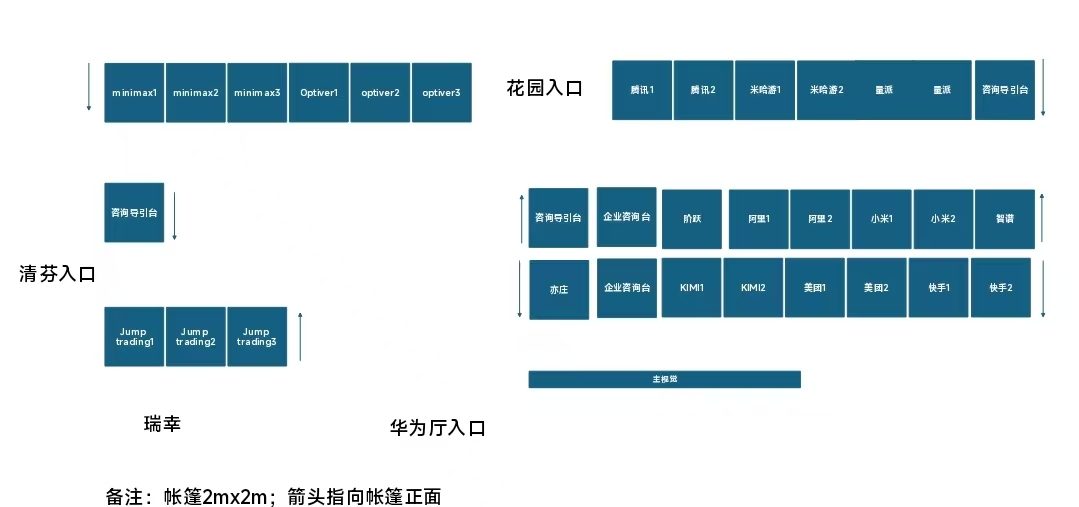


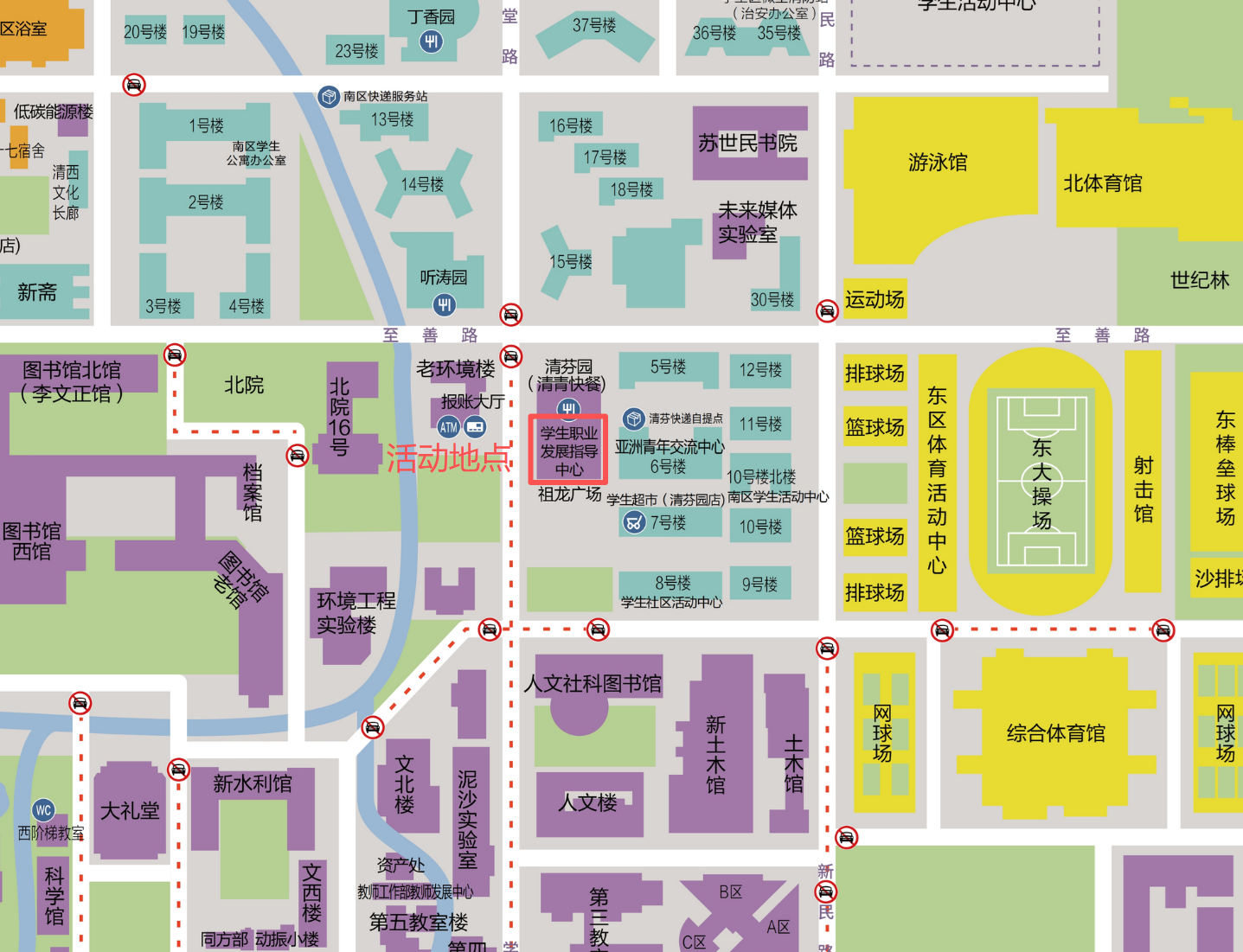
Organizers
感谢所有参与筹备、协调、支持与现场执行的老师和同学。
Acknowledgements
特别感谢 Harry-Chen 和 PACMAN 对网站与活动技术支持的帮助。